
What Is a Fake Sale?
A fake sale is any promotion in which the advertised discount is not a real reduction from a price the item genuinely sold at for a meaningful period of time. The word 'fake' does not always imply illegal activity - many of these tactics exist in a legal gray area or are openly permitted under loose regulatory standards. What they share is an intent to create the perception of savings rather than the reality of them.
The Federal Trade Commission (FTC) has published guidance stating that a former price used as a reference in advertising should reflect a price at which the product was actually offered to the public for a reasonably substantial period. In practice, enforcement is inconsistent, and many retailers operate comfortably within the letter - if not the spirit - of that standard.
Understanding the mechanics of these tactics is the first step toward shopping on your terms, not the retailer's. For a deeper look at how cognitive bias amplifies these signals, see our piece on anchoring, urgency, and scarcity in retail signage.
The Phantom Markdown: Inflating the 'Original' Price
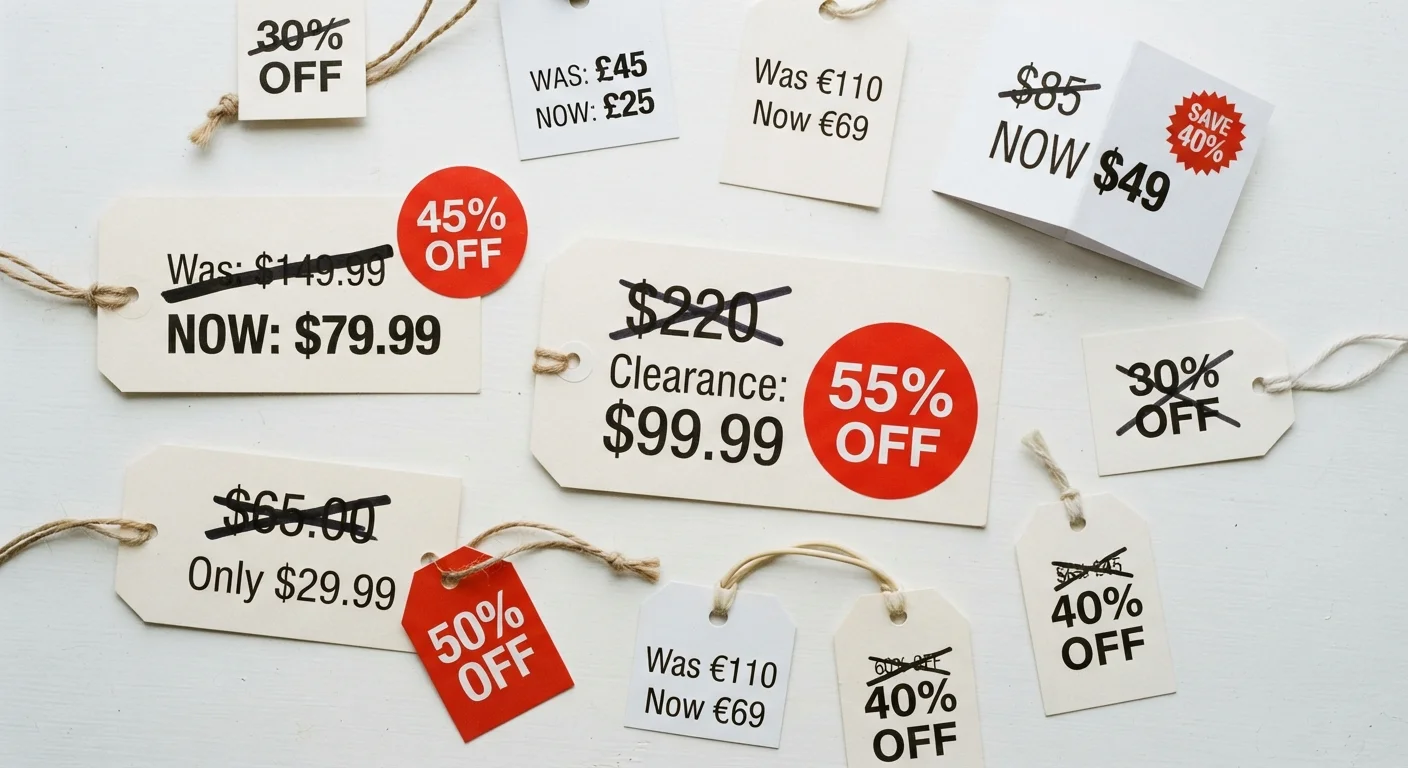
The most common fake-sale mechanism is a simple one: set a high reference price, then discount from it. The strikethrough number on the tag anchors your expectation. Even if the item never sold at that price - or sold there for only a day before being discounted - your brain registers the gap as a gain.
87%
Products never sold at 'original' price
A 2016 investigation by the Government Accountability Office found a significant share of promotional reference prices at major retailers did not reflect genuine prior selling prices.
30-50%
Typical off-price 'compare at' gap
Consumer advocacy research consistently shows off-price retailers use comparison figures 30-50% above actual transaction prices at comparable full-price stores.
4-6 days
Median full-price window before 'sale'
Price-tracking analyses across major e-commerce platforms have documented items spending as few as four to six days at a reference price before permanent discounting begins.
This tactic is especially prevalent in bedding, luggage, furniture, and jewelry, where 'compare at' or 'MSRP' figures are used instead of an actual prior selling price. The manufacturer's suggested retail price (MSRP) is a useful legal shield because the retailer technically never sold at that price - a manufacturer set it. This distinction matters when you're evaluating whether a markdown is genuine.
A closely related technique involves cycling an item through a brief full-price window before placing it on permanent 'sale.' A retailer lists a throw pillow at $60 for 48 hours, then places it on 'sale' at $34 indefinitely. The $60 was real - but it was never a market-clearing price. See how these labeling conventions differ in our breakdown of clearance vs. sale vs. markdown labels.
Artificial Urgency and Scarcity Tactics
Once a discount is anchored in your mind, retailers apply pressure to make you act before you can think clearly. The two dominant tools are urgency (time pressure) and scarcity (quantity pressure).
Countdown timers on e-commerce sites are frequently automated resets - the clock reaches zero and either restarts or the 'sale' simply continues under a new end date. Some timers are personalized to your session rather than reflecting a site-wide deadline. Unless you can verify the end date independently, treat a timer as decoration, not data.
Low-stock warnings like 'Only 3 left!' are sometimes accurate, but they can also reflect warehouse inventory management logic rather than genuine consumer scarcity. A product listed as low-stock in one regional warehouse may be abundantly available elsewhere.
When you encounter a countdown timer, open the product page in a private browser window. If the timer resets or shows a different end time, it is session-based, not a real deadline.
Session-based timers are a well-documented e-commerce practice. A simple incognito test exposes them in seconds and immediately removes the urgency pressure.
For any purchase over $50, search the product name plus 'price history' before buying. Free browser extensions surface this data without requiring account creation.
Price history is the most direct evidence of whether a sale price represents genuine savings. Establishing a 90-day baseline eliminates anchor-price manipulation entirely.
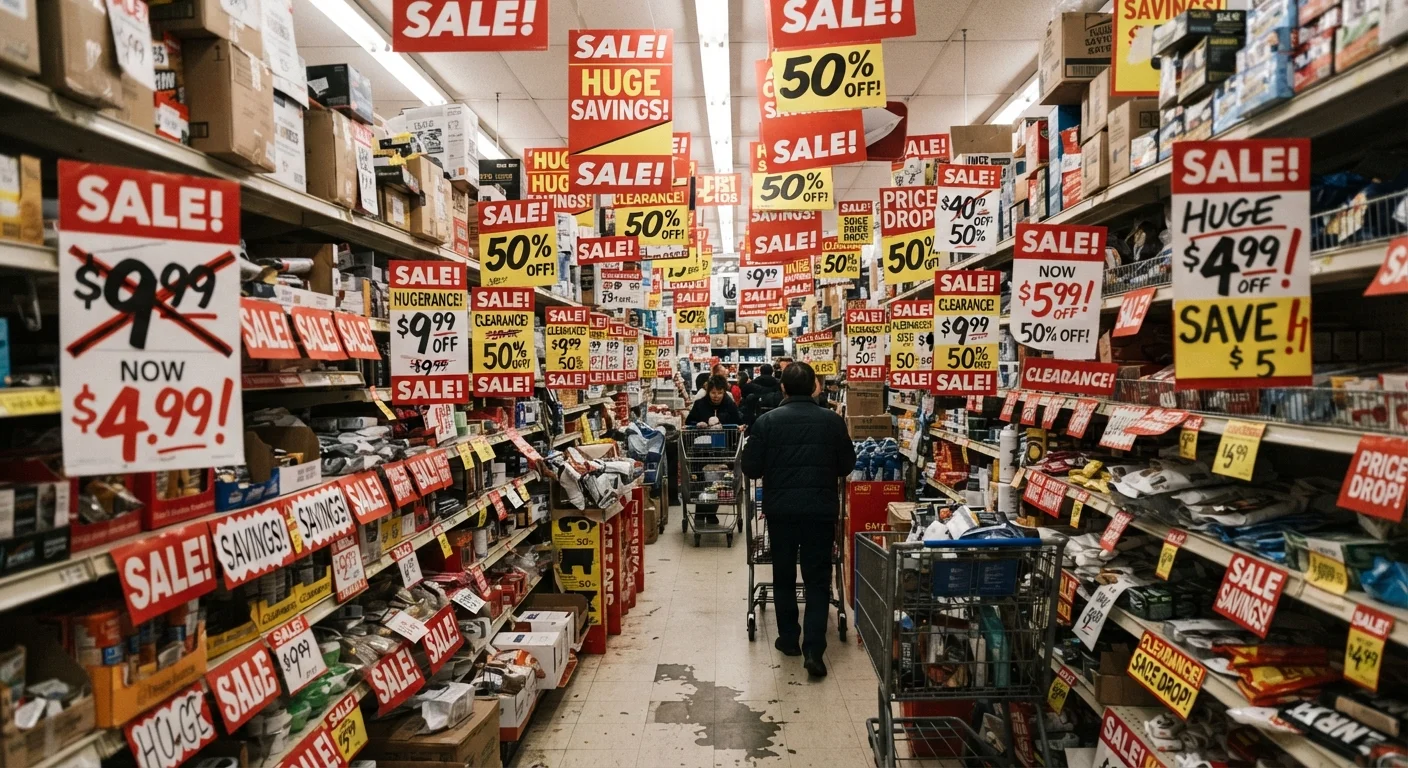
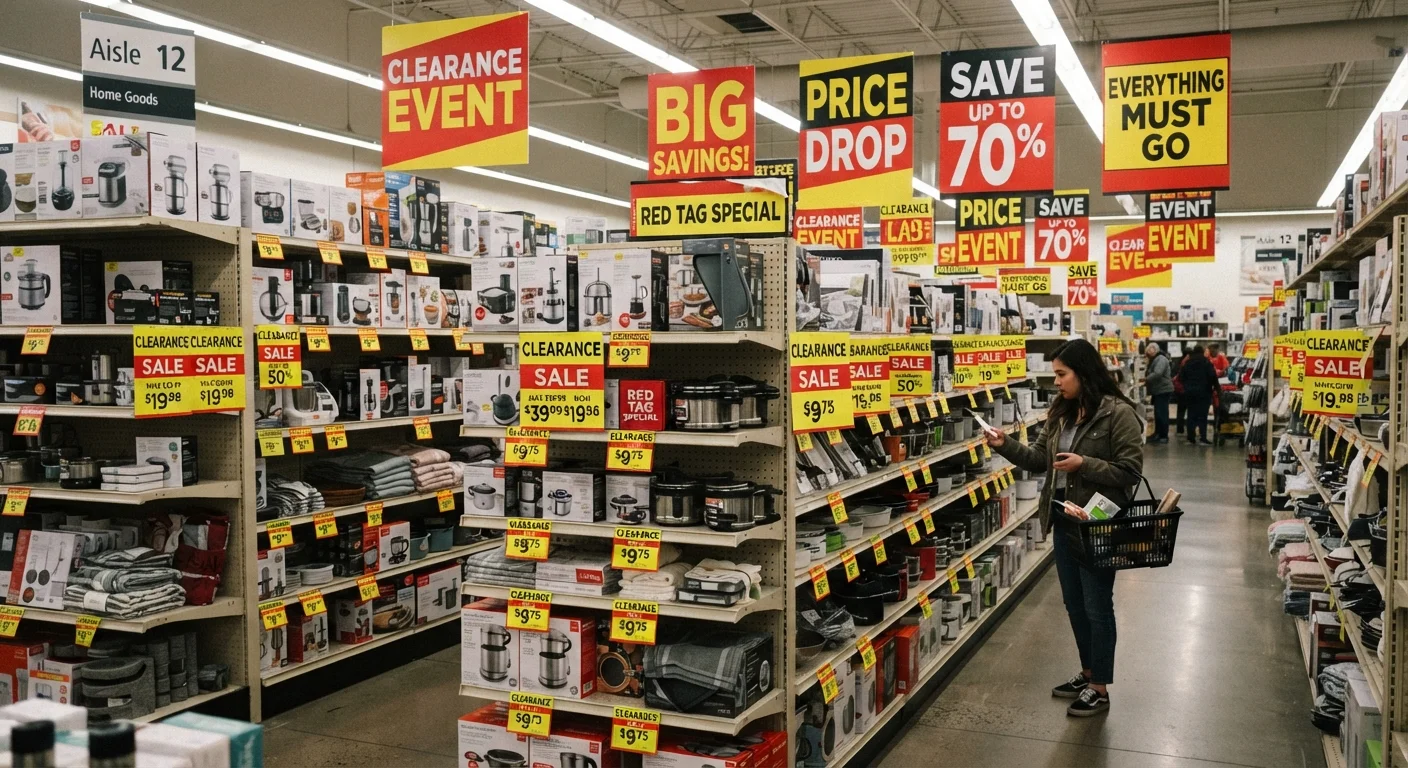
These tactics are not limited to online retail. In-store 'doorbuster' language, limited-quantity signage, and expiring coupon offers serve the same psychological function. The psychology behind sale signage runs deep - recognizing it in real time is a learnable skill.
Category-Specific Tricks to Watch For
Fake-sale mechanics appear across every retail category, but they take on category-specific shapes worth knowing.
- Apparel and home goods: 'Compare at' pricing dominates off-price retail. That comparison figure often reflects a theoretical full-price position, not a price the item sold at in a comparable store.
- Consumer electronics: Bundle inflation - adding low-cost accessories to justify a higher 'original' price before discounting - is common, particularly around major shopping events.
- Grocery: Club-card pricing makes the non-member price the anchor, even when nearly all customers qualify for the member rate. The 'regular' price is rarely what most shoppers pay.
- Automotive: Dealer markups added to MSRP, then discounted back to MSRP, present as savings when they are simply a return to baseline. Our car buying smart hub covers these dynamics in detail.
- Travel and hospitality: Rate anchoring against peak-season pricing or artificial 'rack rates' can make ordinary prices appear discounted.
Knowing the baseline selling behavior of a category lets you apply the right skepticism. Not every promotion in these sectors is manipulative - but each follows patterns that repeat predictably.
How to Verify Whether a Deal Is Real
The single most reliable counter to fake-sale tactics is price history data. Browser extensions and dedicated price-tracking websites maintain historical price records for millions of products across major e-commerce platforms. Before purchasing during any 'sale,' check whether the current discounted price is actually lower than the item's typical selling price over the past 90 days.
For categories where price history tools are less useful - furniture, cars, local services - comparison shopping across at least three vendors gives you a working market price. The goal is to establish a factual baseline, not to find the lowest possible number.
Timing also matters. Certain retail categories discount deeply at predictable calendar points: end-of-model-year automotive, post-holiday apparel, and late-season outdoor goods follow reliable patterns. Our seasonal sales calendars guide maps out when genuine discounts are most likely to occur.
For a broader framework on evaluating any deal before it influences your decision, see our guide on building a smarter shopping habit.
Your Practical Checklist Before You Buy
Apply these questions to any discounted purchase before committing:
- What is the price history? Use a price tracker to confirm the 'original' price reflects actual prior selling prices, not an inflated anchor.
- Is the urgency verifiable? Can you confirm the timer or stock warning with an independent source? If not, assume it is a pressure tactic.
- What does 'compare at' actually mean? Is it the retailer's own former price, a manufacturer's suggested price, or a competitor's price? Each carries a different level of reliability.
- Do I need this item, or am I responding to the discount? A genuine deal on something you don't need is still a net cost. The value vs. price framework helps here.
- Have I checked at least two other sources? Market price confirmation takes two minutes and eliminates most fake-sale vulnerability.
Retail pricing is designed to work on you automatically. The tactics described here succeed most often when shoppers are rushed, emotionally engaged with a product, or simply unaware that these patterns exist. None of them are impossible to counter - they just require a moment of deliberate pause and a few facts you can easily gather yourself.