
How Anchoring Warps Your Sense of a Fair Price
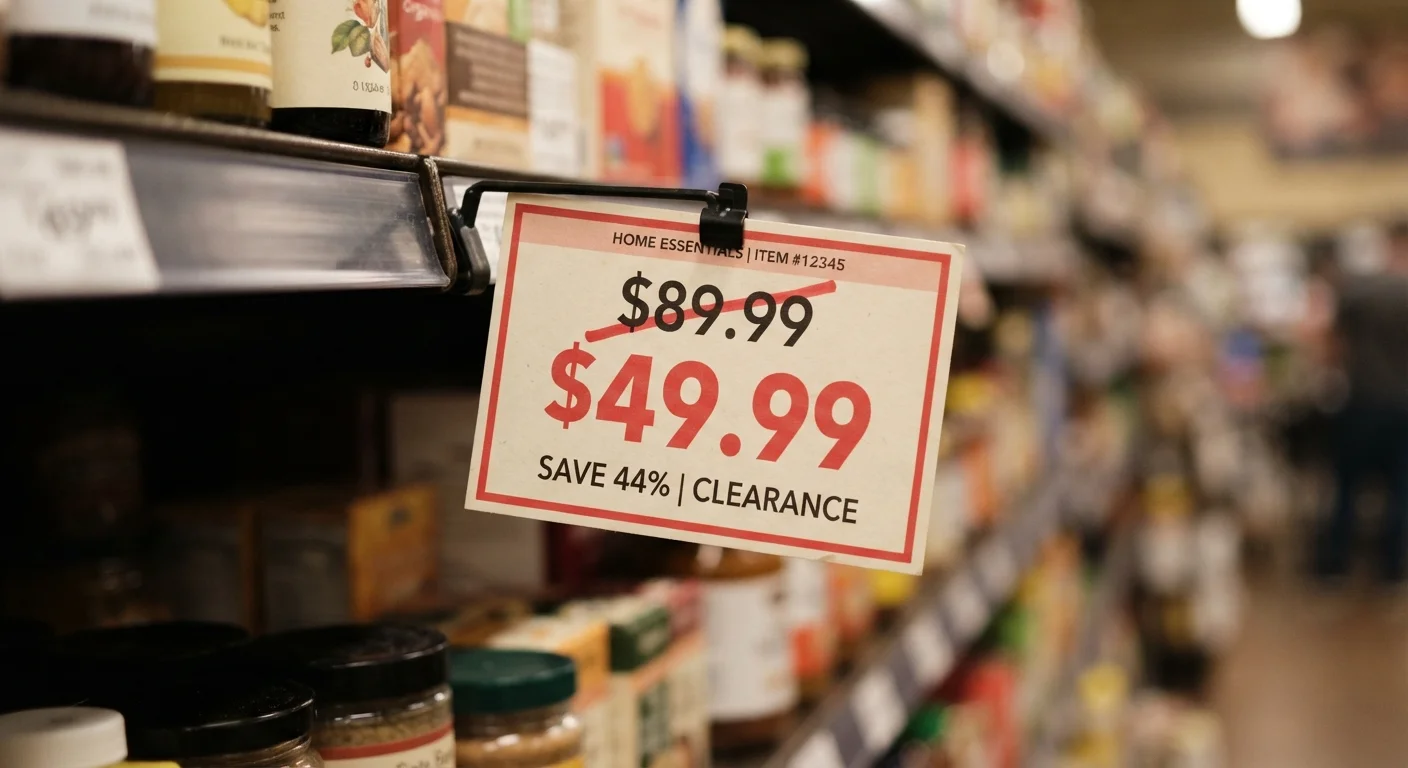
The crossed-out number on a sale tag is doing cognitive work before you even read the actual price. That figure - labeled 'Was,' 'Original,' or 'MSRP' - functions as an anchor. In behavioral economics, the anchoring effect describes how people rely disproportionately on the first piece of numerical information they encounter when making estimates or judgments. In a retail context, that means the original price becomes your benchmark for 'fair,' regardless of whether it reflects what the item actually sold for.
The problem is that anchor prices are sometimes set high specifically to make the sale price look attractive - a practice often called phantom markdown pricing. Regulators in several US states have rules requiring that a 'reference price' must reflect a genuine prior selling price, but enforcement is inconsistent, and the rules vary. The practical result is that a shopper has no reliable way to verify the anchor from the tag alone.
What you can do: treat the crossed-out price as irrelevant and evaluate the actual sale price on its own merits. Would you consider it fair without the anchor present? Anchor pricing mechanics are worth understanding in detail, because the same technique appears across categories from electronics to clothing to grocery store shelf tags.
Reference Price Regulations Vary by State
Some US states require that a 'was' or 'original' price reflect an actual prior selling price held for a minimum period - typically 28-30 days. However, rules differ significantly across jurisdictions, and online retail complicates enforcement further. This means a crossed-out price on a tag is a marketing claim, not a verified fact, and should be treated as such.
Urgency Cues and the Cost of a Countdown
A countdown timer or a 'Sale ends Sunday' banner is designed to activate a well-documented cognitive pattern called hyperbolic discounting - the tendency for people to prefer a smaller reward now over a larger one later. When a deadline is visible, the brain shifts from evaluating whether a deal is good to worrying about whether it will be missed. That shift in framing drives faster, less deliberate decisions.
Urgency language appears across every retail channel: email subject lines, app notifications, in-store banners, and e-commerce product pages. The specific formats differ, but the mechanism is the same - impose a time constraint to reduce the window in which a shopper might reconsider, compare prices elsewhere, or simply walk away.
A useful counter-habit is to ask one question before any time-pressured purchase: If this deal disappears tonight, will I regret not buying this in a week? If the honest answer is no, the urgency cue has done its job without delivering genuine value. Evaluating any discount before it tempts you covers a practical framework for exactly this kind of check.
Use Price History Tools Before Buying
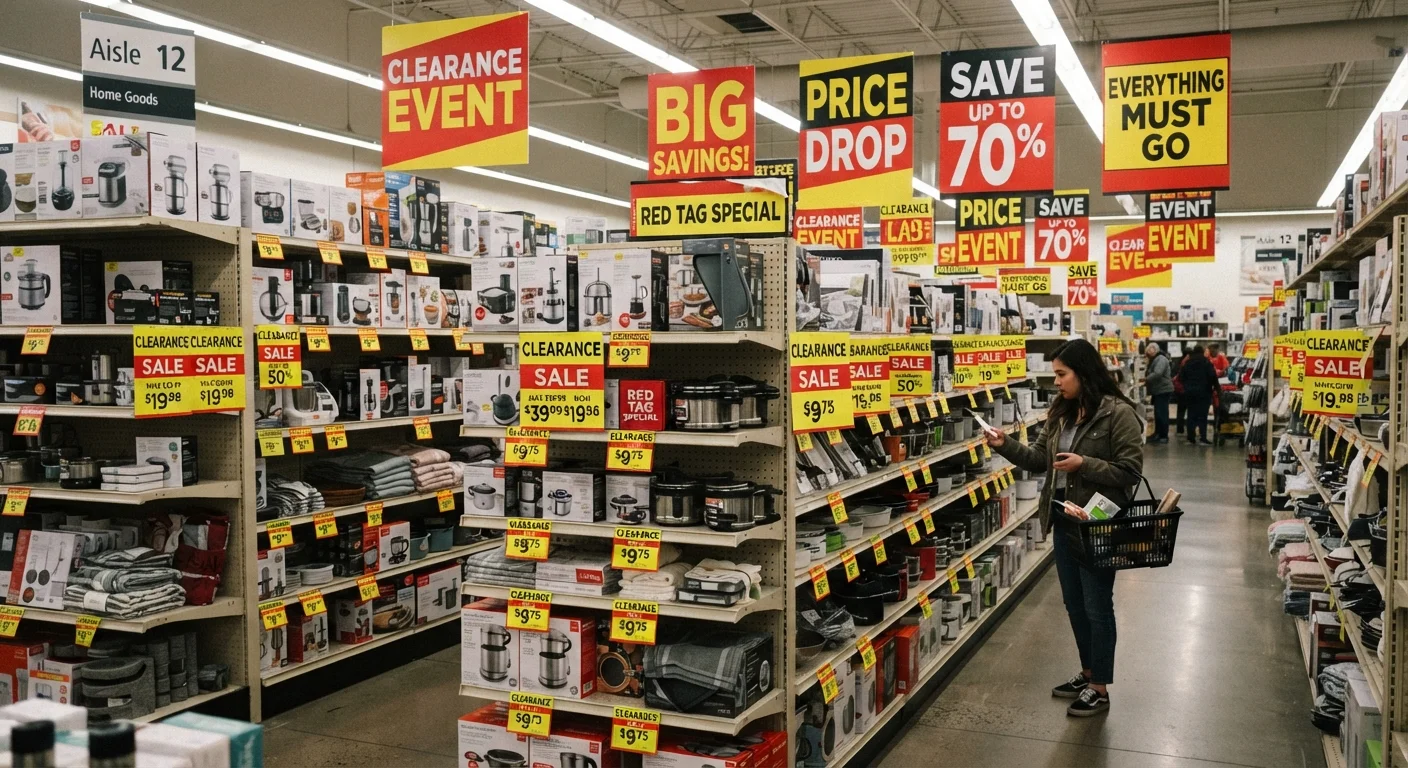
Browser extensions and dedicated websites track historical prices for major online retailers, letting you see whether a 'sale' price is genuinely lower than usual or simply the standard price with a new label. Checking a 90-day price chart takes under a minute and immediately defuses the anchoring effect. This habit is especially useful before major retail events when sale signage is most aggressive.
Scarcity Signals and Loss Aversion
'Only 3 left in stock.' 'Selling fast.' 'Low inventory.' These phrases are scarcity signals, and they work because of loss aversion - a finding from behavioral economics suggesting that people feel the pain of a loss more acutely than the pleasure of an equivalent gain. Framed as potential scarcity, a purchasing opportunity stops being about acquiring something and starts being about not losing an opportunity.
Scarcity cues are particularly effective online, where stock counters and 'X people are viewing this item' notifications are easy to display - and easy to configure. Unlike physical shelf space, a digital scarcity claim is entirely within the retailer's control. That doesn't mean every low-stock warning is fabricated, but it does mean the signal alone isn't reliable evidence of genuine scarcity.
Real scarcity most often appears in specific, verifiable contexts: end-of-model-year automotive inventory, genuine closeout clearance, or seasonal items with fixed production runs. Understanding what clearance, sale, and markdown labels actually signal can help you distinguish those situations from a routine marketing tactic wearing a scarcity costume.
When All Three Appear Together
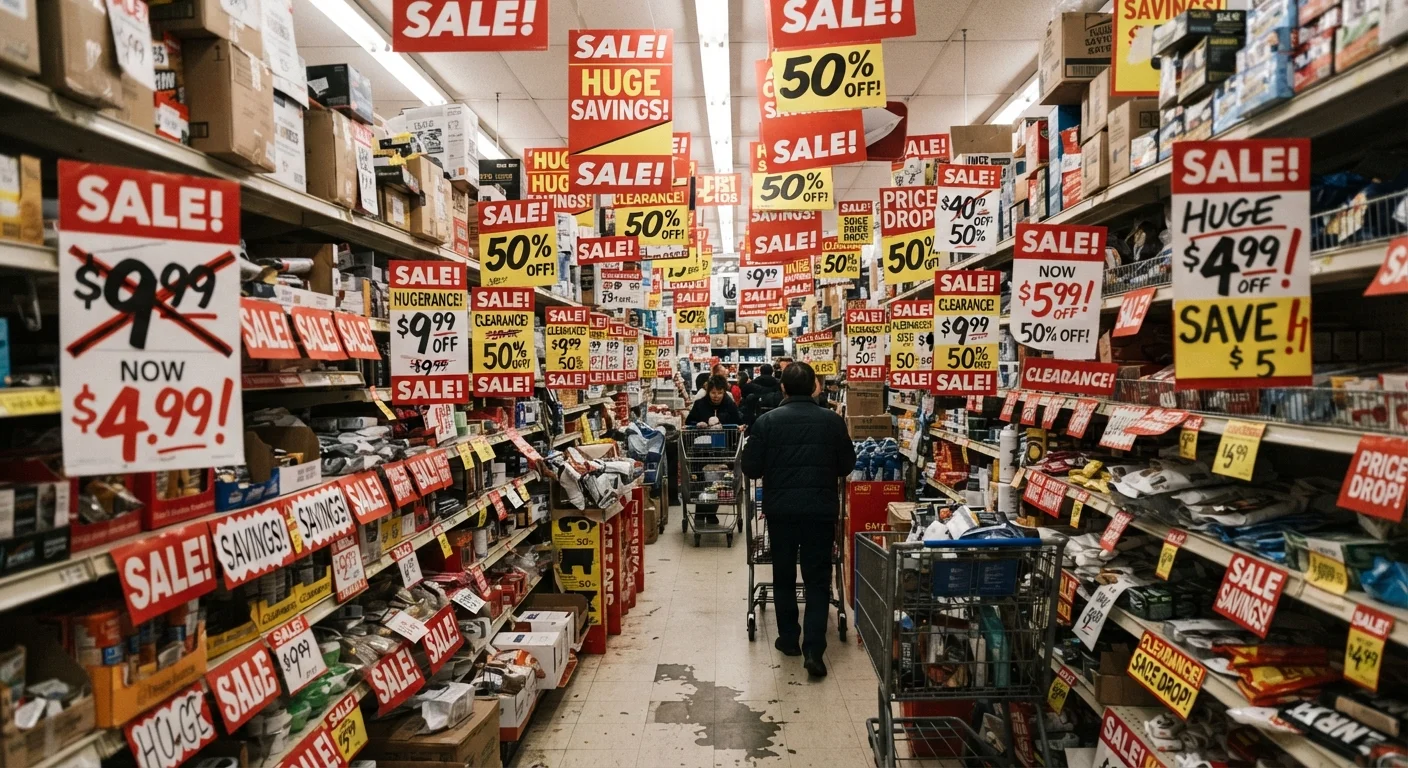
The most effective sale displays stack anchoring, urgency, and scarcity simultaneously: a large crossed-out original price (anchor), a countdown to end of sale (urgency), and a low-stock indicator (scarcity). Each mechanism reinforces the others. The anchor establishes perceived value. The timer compresses decision time. The scarcity claim increases the emotional cost of waiting. Together, they can push a purchasing decision that none of the three cues would have triggered independently.
This combination is common during high-volume retail events and is not limited to any single category - it appears in electronics, apparel, travel bookings, and automotive financing contexts alike. The anatomy of a fake sale examines how these patterns combine across retail categories. Spending triggers that shape unplanned purchases covers the broader situational context in which these signals land.
Awareness of the stacking effect is a practical defense. When you notice more than one of these cues on a single item, treat it as a signal to slow down rather than speed up. The intensity of the marketing pressure often bears no relationship to the quality of the underlying deal.
~60%
Shoppers who make unplanned purchases during sales events
Research on consumer behavior consistently finds that the majority of sale-event purchases were not on shoppers' pre-visit lists, reflecting the effectiveness of in-store urgency and discount signage.
2:1
Ratio at which losses outweigh gains in perceived impact
Behavioral economists Kahneman and Tversky established through repeated experiments that losses are typically felt roughly twice as intensely as equivalent gains, underpinning the power of scarcity and urgency framing in retail.
Up to 30%
Price variation for identical items across major retailers
Consumer price-tracking analyses have found that the same product can carry a price range of 20-30% across major US retailers at any given time, making independent price comparison essential when evaluating any anchor-based discount.