
How Each Method Actually Works
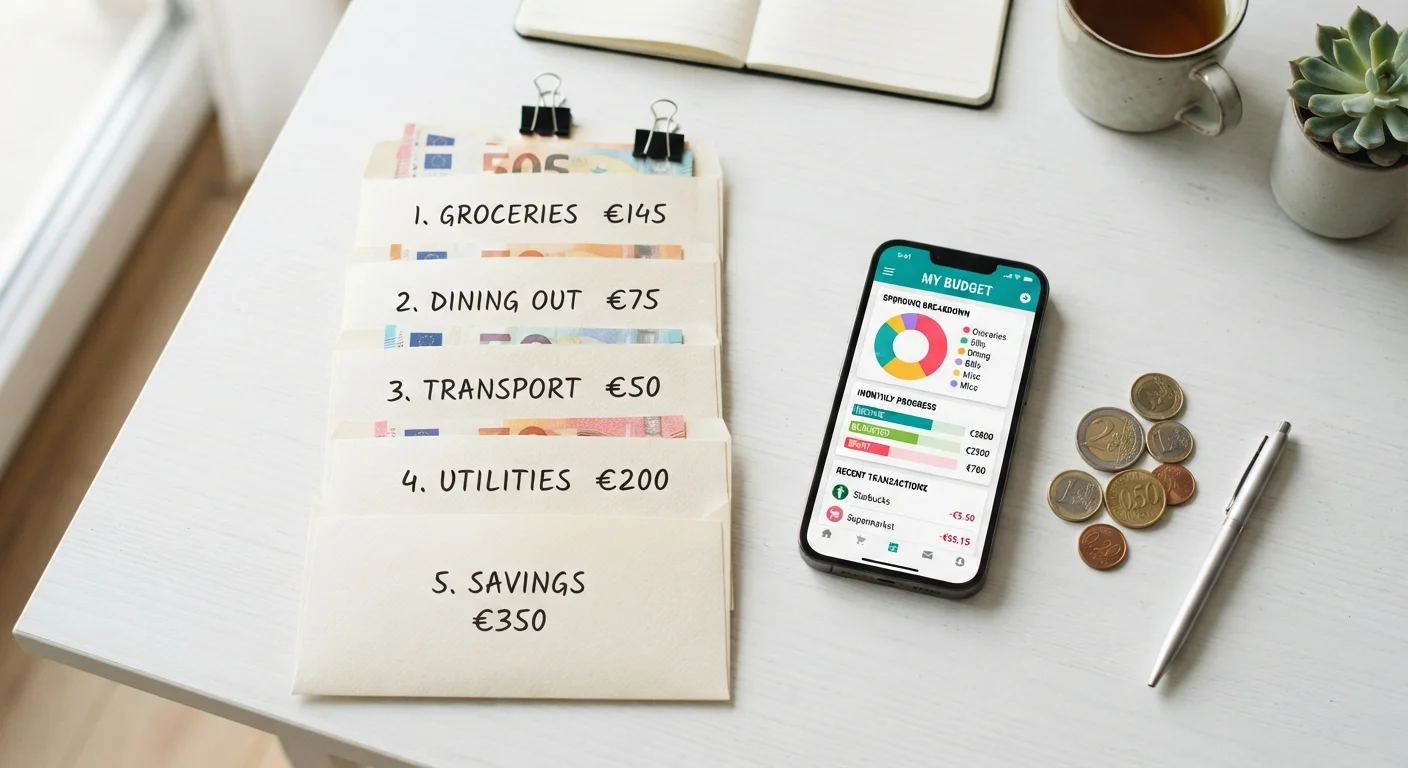
The cash envelope system is straightforward: at the start of each pay period, you withdraw physical cash and divide it into labeled envelopes — one per spending category, such as groceries, dining out, gas, and personal care. When an envelope is empty, spending in that category stops until the next funding cycle. No transfers, no exceptions by default.
Digital budgeting apps work differently. You connect your bank accounts, credit cards, and other financial accounts to the app. Transactions import automatically (or are logged manually), and the app categorizes them against the budget limits you set. You see your remaining balance in each category on your phone in real time.
Both methods ultimately serve the same purpose described in effective spending tracking: closing the gap between what you think you spend and what you actually spend. The difference lies entirely in the mechanism of enforcement.
| Criterion | Cash Envelope System | Digital Budgeting Apps |
|---|---|---|
| Spending enforcement | Hard stop when envelope empties | Alerts and limits, but spending continues |
| Setup effort | Low — envelopes, cash, labels | Moderate — account linking, categorization |
| Works for online purchases | No | Yes |
| Automated tracking | No — fully manual | Yes — imports most transactions |
| Privacy considerations | No data shared externally | Requires sharing account credentials |
| Multi-account visibility | No | Yes — aggregates all accounts |
| Behavioral friction | High — physically handing over cash | Low — same card tap as always |
| Best budget category fit | Discretionary, in-person spending | Digital, recurring, and mixed spending |
The Psychology Behind Each Approach
The case for cash envelopes has a behavioral basis. Research on cash versus card spending consistently finds that paying with physical money tends to feel more "painful" than swiping a card, which can reduce discretionary spending. When you hand over a $20 bill, you feel the transaction in a way a contactless tap does not replicate.
Digital apps address a different psychological challenge: invisibility. Most people underestimate their monthly spending by a significant margin because small card transactions are forgettable. An app that shows you spent $340 on dining when you thought it was closer to $150 creates its own kind of wake-up call — one grounded in data rather than a drained wallet.
18%
Average reduction in spending with cash payments
A study published in the Journal of Consumer Research found participants spent roughly 18% less when paying with cash versus a credit card in equivalent scenarios.
~$300
Monthly amount most Americans underestimate their spending
Surveys by financial wellness organizations consistently find that self-reported monthly spending falls several hundred dollars short of actual bank and card statement totals.
The right approach often depends on where your spending problem lives. If you struggle most with in-person, discretionary categories, the physical friction of envelopes is harder to rationalize away. If your problem is subscription creep, bill overlap, or digital convenience purchases, an app's automated tracking is more aligned with the challenge.
Practical Trade-offs to Consider
Envelopes have real limitations. Carrying cash is less safe than a card, inconvenient for online purchases, and impractical for recurring automatic payments like rent or utilities. Replenishing envelopes also requires a trip to the ATM each pay period — a routine that some people find motivating and others find friction-heavy enough to abandon.
Apps introduce their own friction points. Connecting accounts requires sharing financial credentials with a third-party platform, which raises legitimate privacy concerns for some users. Automatic categorization is rarely perfect; restaurants might be filed under dining or entertainment inconsistently, requiring manual correction. And the digital convenience that makes apps easy to check also makes it easy to rationalize: seeing $47 left in your dining envelope on a screen feels less real than holding $47 in cash.
For a fuller picture of where these and other frameworks sit relative to each other, the comparison of major budgeting methods covers zero-based, pay yourself first, and other approaches in detail.
A hybrid strategy — using cash envelopes for two or three high-risk categories while tracking everything else in an app — is worth considering if neither pure approach fits your life. It captures the behavioral benefit of cash where you need it most, without the logistical headaches of running an entirely cash-based household.
Hybrid Budgeting Is a Legitimate Strategy
You don't have to choose one method exclusively. Many budgeters use cash envelopes for two or three categories where they consistently overspend — often groceries and dining — while relying on an app to track fixed costs, bills, and online purchases. This approach captures the behavioral benefit of physical cash without requiring you to run an entirely cash-based household. Start with your biggest problem category and expand from there.
Choosing What Fits Your Spending Reality
Before committing to either method, spend one month doing a monthly budget audit to identify which categories routinely blow past your intended limits. That data shapes which tool is better suited to your situation.
If the problem categories are in-person and discretionary — food, coffee, clothing, entertainment — the cash envelope system addresses the root behavior directly. If overspending is spread across digital subscriptions, online shopping, and automatic renewals, a tracking app surfaces the problem in a way envelopes never could.
Neither method requires perfection from the start. Both reward consistency over time. The comparison between envelope budgeting and spreadsheet budgeting explores accountability in more depth if you are weighing cash envelopes against yet another alternative. The right system is simply the one you will actually use.
This article is for general informational purposes only and does not constitute personalized financial advice. Consider consulting a qualified financial professional for guidance specific to your situation.