
Why Pet Food Label Language Matters
Pet food packaging is regulated at the federal level by the FDA and guided by standards set by the Association of American Feed Control Officials (AAFCO). The result is a label dense with technical language that can feel impenetrable to everyday shoppers. Knowing what terms like complete and balanced, crude protein, and life stage actually mean lets you evaluate any bag or can on its merits - not just its price tag or marketing design.
This glossary covers the terms you're most likely to encounter on a standard U.S. pet food label. For a practical walkthrough of how to apply these definitions at the store shelf, see our budget-focused pet food checklist.
AAFCO
The Association of American Feed Control Officials is a non-governmental body that develops model regulations and nutrient profiles used as standards for pet food in the U.S. AAFCO itself does not test or approve foods; individual states adopt and enforce these guidelines.
Complete and Balanced
A label claim indicating the food meets AAFCO nutrient profiles for a stated life stage. It means the food can serve as a sole diet - no supplementation is required. Foods without this claim should only be used as treats or supplements to a complete diet.
Crude Protein
A measure of total nitrogen content in the food, converted to an estimated protein value. It reflects all nitrogen sources - including non-protein nitrogen - not just digestible protein. High crude protein percentages don't automatically mean high digestibility.
Crude Fat
The total fat content of a food, measured by ether extraction. Fat is the most calorie-dense macronutrient in pet food and provides essential fatty acids. Crude fat percentages vary widely between food types and life-stage formulas.
Guaranteed Analysis
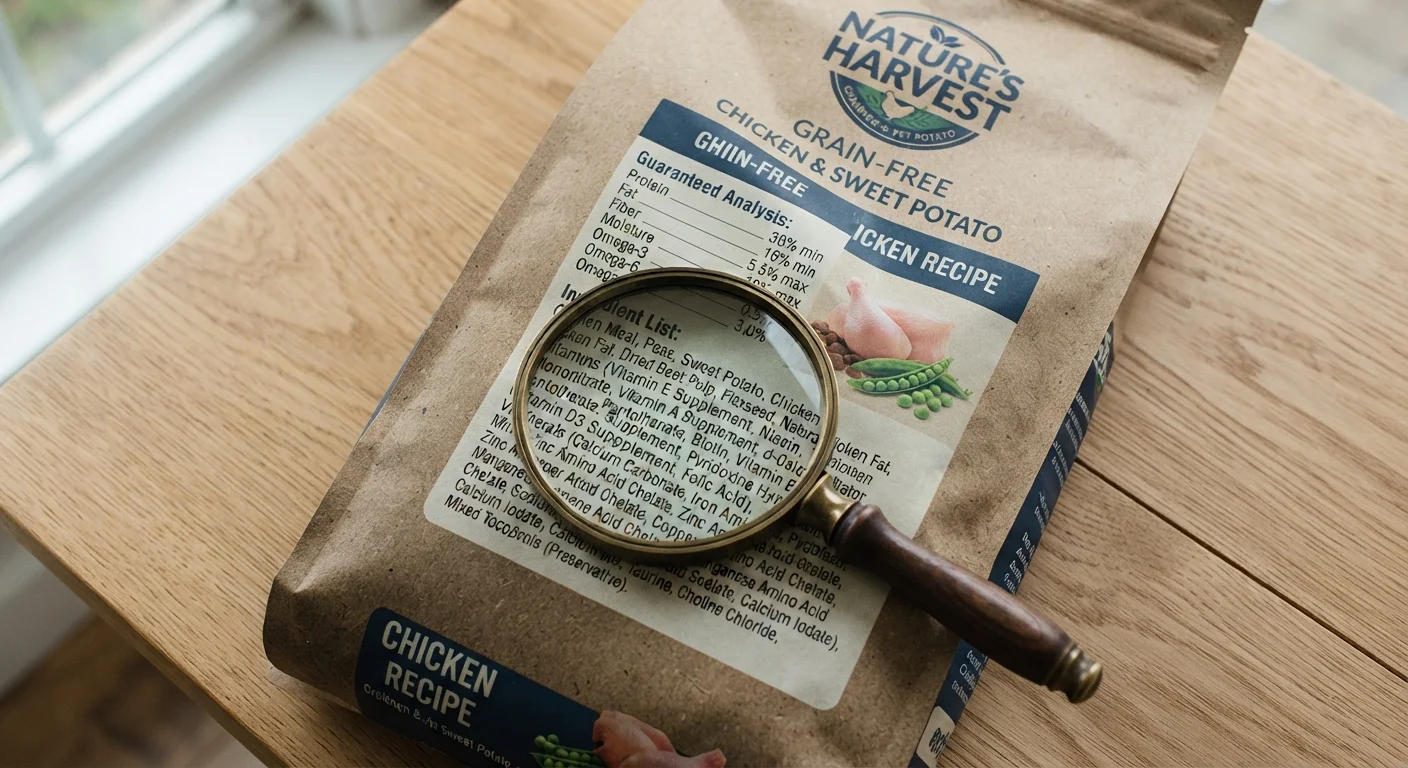
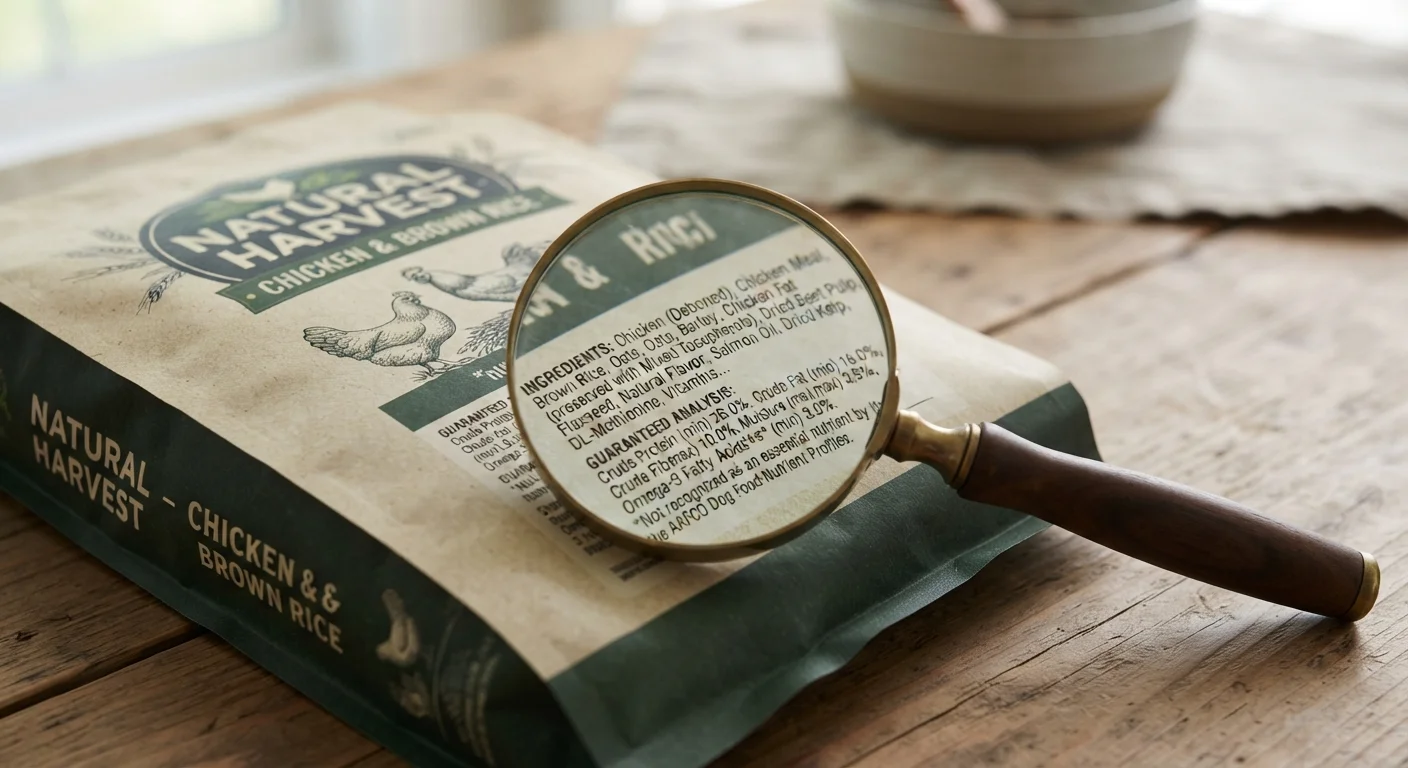
The panel on a pet food label that lists minimum percentages of crude protein and crude fat, and maximum percentages of crude fiber and moisture. These are legal guarantees, not exact values, and represent the worst-case nutritional floor for each batch.
Dry Matter Basis
A calculation method that removes the effect of moisture content so foods with different water levels can be compared fairly. Divide the as-fed percentage of a nutrient by the percentage of dry matter (100 minus moisture %), then multiply by 100.
Life Stage
A classification - growth (puppy/kitten), adult maintenance, all life stages, or senior - that indicates which AAFCO nutrient profile the food is formulated to meet. Feeding the wrong life-stage formula can result in nutritional imbalances over time.
Meat Meal
Rendered, dried animal tissue with most of the moisture removed. Meat meal contains a higher concentration of protein per pound than whole fresh meat and is a common, legitimate protein source in dry pet foods.
By-Products
Animal-derived ingredients that are not skeletal muscle - including organs, blood, and bone. Named by-products (e.g., chicken liver) are traceable and can be nutritionally dense; generic terms (e.g., poultry by-products) indicate a less specific source.
Feeding Trial
An AAFCO-defined protocol in which animals are actually fed the food over a set period to confirm it sustains health. A feeding trial substantiation claim is considered stronger evidence of adequacy than formulation to meet nutrient profiles alone.
Caloric Content Statement
A required statement on most U.S. pet foods listing kilocalories per kilogram and per common household measure (cup or can). It allows direct calorie comparison across brands and formats.
Grain-Free
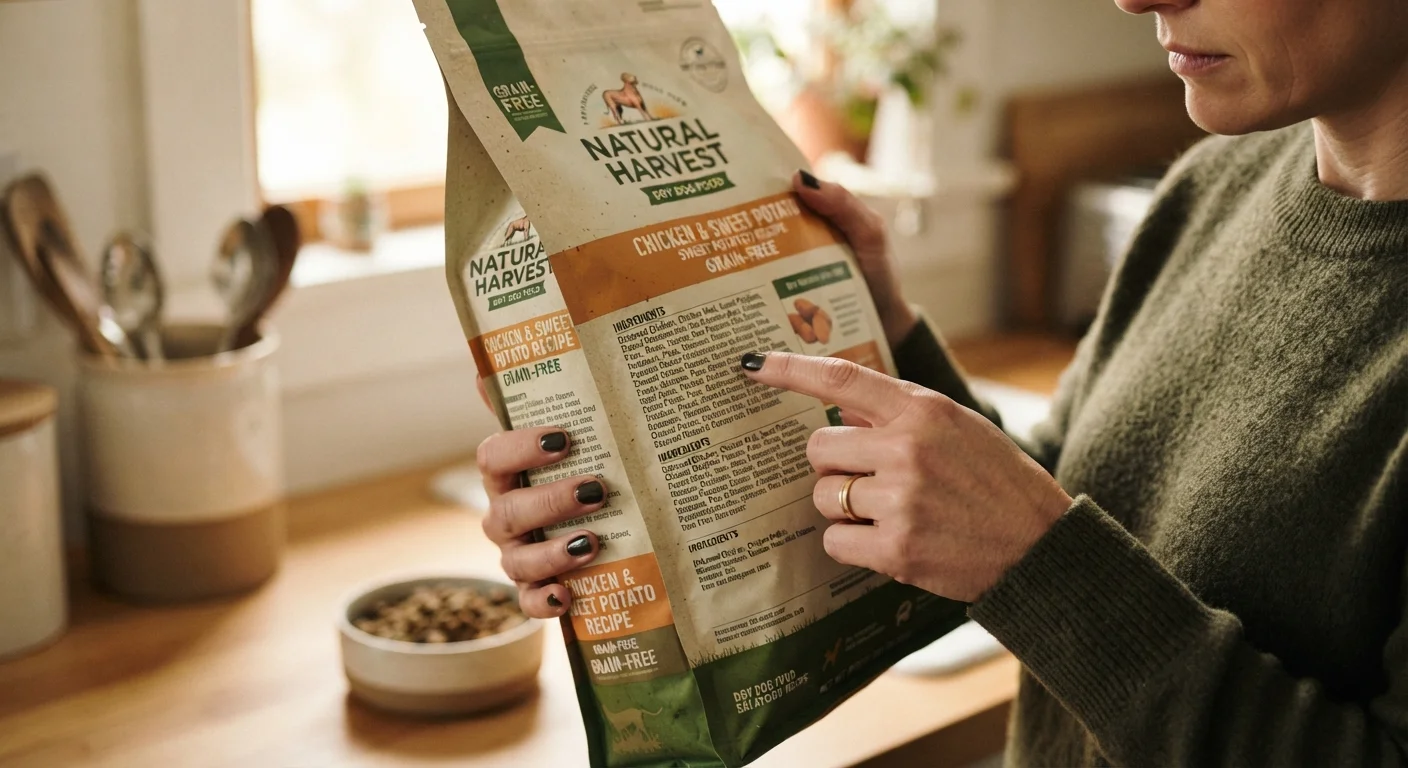
A label term indicating no corn, wheat, rice, oats, or other cereal grains are used. Grain-free does not mean low-carbohydrate - many grain-free foods replace grains with legumes or potatoes. Pet owners should consult a veterinarian before choosing grain-free diets, particularly for dogs.
Reading the Guaranteed Analysis Panel
The guaranteed analysis panel lists minimum or maximum percentages for key nutrients - crude protein, crude fat, crude fiber, and moisture. These figures describe what the food guarantees at minimum (or maximum), not the exact content of every batch. Because moisture levels differ dramatically between wet and dry foods, comparing guaranteed analysis numbers across formats requires converting to a dry matter basis - a calculation that strips out moisture to put foods on equal footing.
| Moisture cap in dry food | Max 10-12% (AAFCO Model Regulations) |
| Moisture cap in canned/wet food | Typically 75-82% (General industry range) |
| Nutrient profiles maintained by | AAFCO Canine & Feline Nutrition Expert subcommittees (AAFCO.org) |
| Life stages defined by AAFCO | Growth, Adult Maintenance, All Life Stages, Gestation/Lactation (AAFCO Model Regulations) |
| Ingredients listed by | Descending pre-cooking weight (FDA pet food labeling requirements) |
| Caloric content statement required | Yes, for most complete pet foods sold in the U.S. (FDA 21 CFR Part 501) |
For a full breakdown of how to use these numbers in practice, our companion article decoding pet food nutrition labels walks through the math step by step. Understanding what each nutrient does for your pet's body is covered in our nutrient overview for dogs and cats.
Dry Matter Basis: A Quick Example
If a canned food shows 10% crude protein and 78% moisture, its dry matter is 22%. Divide 10 by 22 and multiply by 100 to get approximately 45% protein on a dry matter basis. That's directly comparable to a dry kibble's guaranteed analysis - which is already close to dry matter because kibble moisture is so low. Running this calculation prevents misleading apples-to-oranges comparisons between wet and dry foods.
Ingredient List, By-Products, and Other Common Terms
Ingredients are listed in descending order by pre-cooking weight. A named meat (e.g., chicken, salmon) listed first indicates it was the heaviest single ingredient before processing - but this doesn't necessarily mean it dominates the finished food, because cooking reduces moisture and weight significantly. Meat meal (e.g., chicken meal) is already dried, so it delivers more concentrated protein per pound than whole fresh meat.
By-products are parts of the animal other than skeletal muscle: organs, blood, bone. Nutritionally, many by-products are rich in protein and micronutrients; the term doesn't automatically signal lower quality. What matters more is whether a by-product is named (chicken by-product meal) rather than generic (poultry by-product meal), which indicates a more consistent, traceable source.
Budget-conscious pet owners caring for their animals at home may find related savings strategies in our DIY pet care hub, which covers everything from at-home grooming to enrichment that keeps costs manageable.