

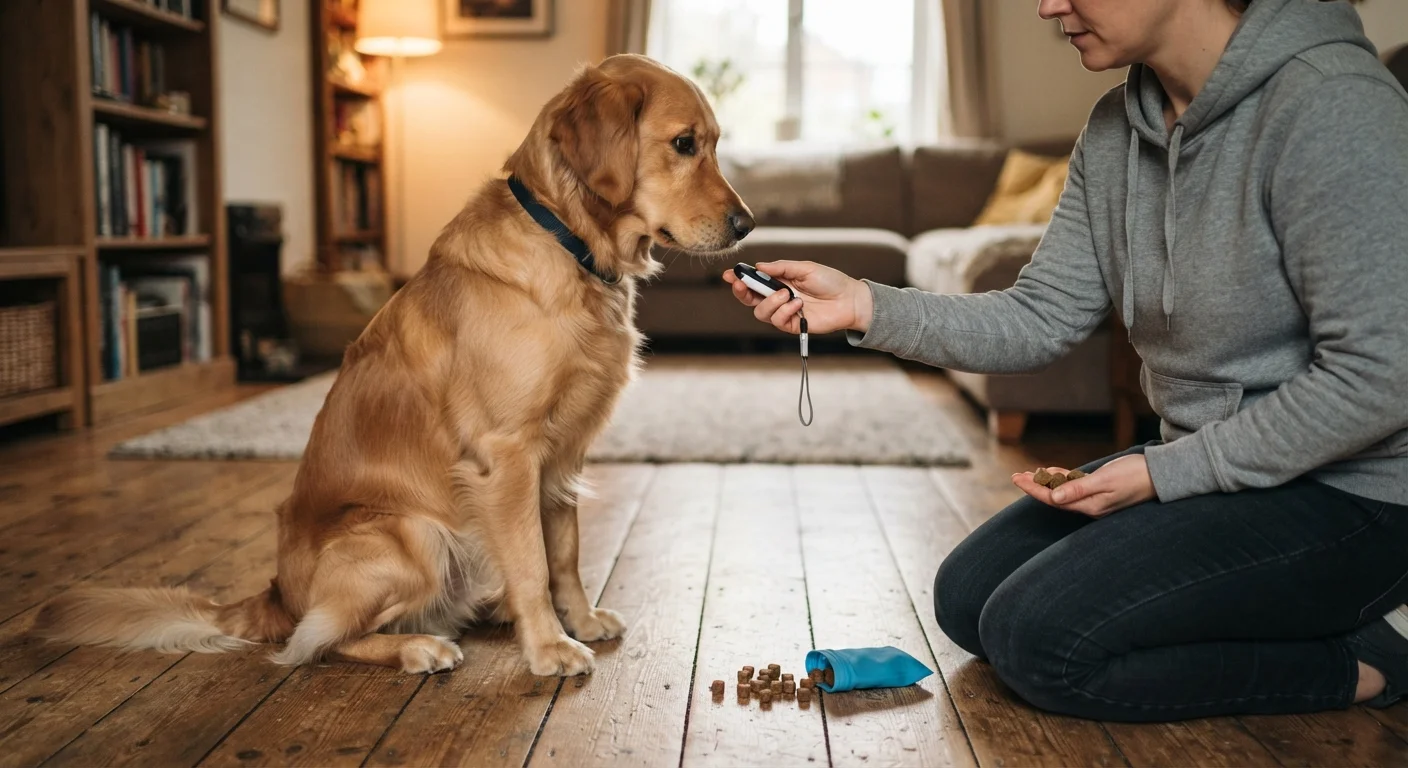
How Each Method Actually Works
Both clicker training and treat-only training belong to the broader category of positive reinforcement - rewarding a dog for performing a desired behavior to make that behavior more likely to happen again. The distinction lies in how the reward signal is delivered.
In clicker training, a small handheld device produces a short, consistent clicking sound. The click serves as a marker - it tells your dog precisely which moment in time earned the reward. The treat follows the click, but the click itself is what communicates "that's exactly what I wanted." This two-step sequence (mark, then reward) is grounded in the science of operant conditioning and was popularized in animal training by behaviorists studying how animals learn through consequences.
Treat-only training removes the marker entirely. The dog receives a food reward directly after performing the behavior. Without a distinct marker, timing becomes more critical - a half-second delay in food delivery can inadvertently reinforce whatever the dog happens to be doing at that moment rather than the intended action.
See our guide to teaching basic commands without a trainer for a practical walkthrough of positive reinforcement techniques you can apply with either method.
| Criterion | Clicker Training | Treat-Only Training |
|---|---|---|
| Equipment needed | Clicker + treats | Treats only |
| Upfront cost | Minimal (clicker under $5) | None beyond treats |
| Timing precision | High - click marks exact moment | Relies on fast treat delivery |
| Handler learning curve | Moderate - click timing takes practice | Low - intuitive for beginners |
| Speed of behavior acquisition | Generally faster early on | Slightly slower without a marker |
| Suitable for noise-sensitive dogs | Not always | Yes |
| Long-term effectiveness | High with consistent use | High with consistent use |
Cost, Convenience, and the Learning Curve
From a budget standpoint, both approaches share the same primary expense: training treats. Small, soft, high-value treats are recommended for training sessions regardless of method, and those costs are identical. The only additional investment for clicker training is the clicker itself, which is widely available for under a few dollars.
Where the methods diverge is handler skill. Clicker training requires you to develop good timing - clicking at precisely the right moment takes practice. New trainers often click too late, which defeats the marker's purpose. Treat-only training is more forgiving on this front; you simply deliver the treat as quickly as possible after the correct behavior.
That said, once handlers get comfortable with the click-treat sequence, many find sessions feel more efficient and less ambiguous for the dog. Dogs trained with a marker often generalize new behaviors faster because the feedback is unambiguous.
~$3-5
Typical cost of a basic clicker
Clickers are among the least expensive training tools available, making the cost barrier to entry essentially negligible for most pet owners.
5 min
Recommended daily training session length
Animal behavior researchers and trainers broadly recommend short, frequent sessions to maintain dog engagement and maximize retention of new behaviors.
2 steps
Core sequence in clicker training
The mark-then-reward sequence - click, then treat - is the foundational structure that distinguishes clicker training from direct reward delivery.
When to Switch, Combine, or Skip the Clicker
The two methods aren't mutually exclusive. Many trainers use clickers during the acquisition phase - when a dog is first learning a new behavior - then transition to treat-only reinforcement once the behavior is reliably established. This mirrors how professional animal trainers phase out markers over time as behaviors become habitual.
There are genuine cases where treat-only is the stronger choice from the start. Dogs with significant noise sensitivity may associate the click with stress rather than reward, undermining the entire training process. In those cases, a verbal marker like a short word ("yes") can serve the same timing function as the click - or you can simply rely on fast, consistent treat delivery alone.
For most budget-conscious pet owners doing training at home, the choice often comes down to personal preference and consistency. The most effective training method is the one you'll actually practice regularly. Frequent, short sessions - even five minutes a day - produce better results than occasional long ones, regardless of whether a clicker is involved.
For a related comparison of DIY care versus professional services, our article on brushing vs. professional deshedding treatments illustrates how at-home routines consistently deliver strong results when applied correctly.
This article is for general informational purposes only and is not a substitute for personalized guidance from a certified professional dog trainer or veterinary behaviorist.