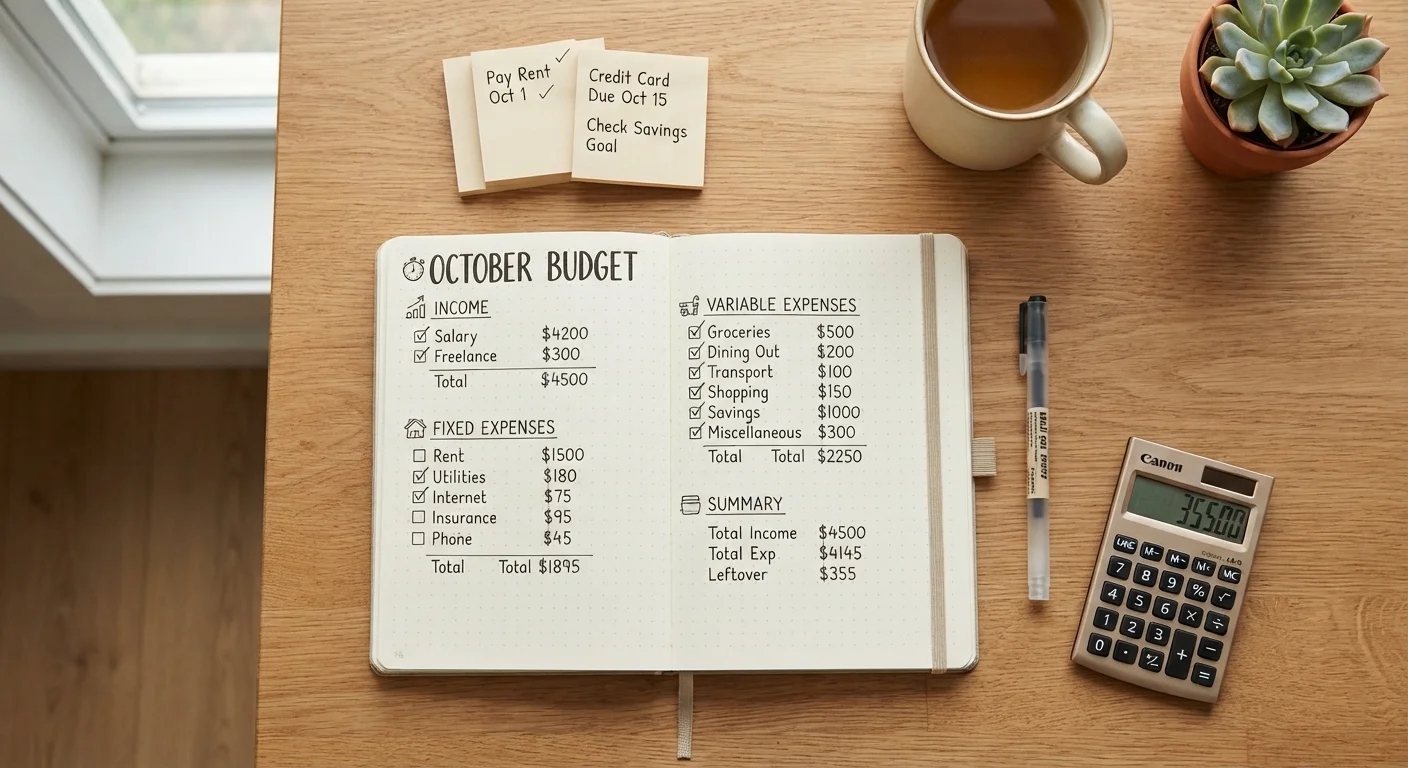
Use this end-of-month checklist to review what worked, catch overspending early, and set up a stronger plan for the month ahead.
Key Takeaways
Reviewing last month's actual spending before building a new budget catches errors most people miss.
Checking subscriptions and recurring charges monthly prevents bill creep from quietly draining your account.
Resetting savings targets and irregular expenses at month-end keeps your budget grounded in reality.
A structured reset routine takes under an hour and compounds into major savings over time.
Tracking income changes is just as important as tracking spending when income is variable.
Why a Month-End Reset Matters
Most budget advice focuses on setting a plan at the start of the month. The problem is that a plan you never review is just a wish list. A monthly reset — done in the final few days of each month — bridges the gap between what you planned to spend and what actually happened. It's the step that turns budgeting from a one-time task into a working system.
This checklist is built for budget-conscious millennials dealing with irregular income, rising rents, and the constant creep of subscription costs. You don't need fancy software, though the right tools help. What you need is about 30 to 60 minutes, your bank statements, and this list. For a deeper look at where money leaks by category, the room-by-room budget audit pairs well with this reset routine.
Don't Build Next Month's Budget from Memory
One of the most common budgeting mistakes is drafting next month's numbers without reviewing actual statements first. Memory consistently underestimates spending — particularly on dining, impulse purchases, and small recurring charges. Always start from real data, not what you think you spent.
Tools You'll Need
Before you start, gather what you need. Working from memory leads to estimates — and estimates are where budgets break down.
Required
Last month's bank and credit card statements
Provides the actual transaction data you'll review against your budget plan.
Required
Your original monthly budget (written or digital)
Gives you the baseline to compare planned versus actual spending.
Required
Spreadsheet or budgeting app
Used to record variances, update category totals, and build next month's plan.
Required
List of all active subscriptions
Allows you to cross-check recurring charges and catch anything unused or unexpected.
Optional
Upcoming calendar or bills list
Helps you identify irregular expenses due next month (annual fees, quarterly bills, etc.).
The Full Reset Checklist
Work through these groups in order. The first two groups are backward-looking (what happened last month), and the final groups are forward-looking (what to plan for next month).
Review Last Month's Income
Confirm your total take-home income for the month, including any side income, freelance payments, or irregular deposits.Must
Flag any income that was higher or lower than expected, and note the reason so you can account for it going forward.Must
If your income varies month to month, record this month's figure in a running log to better estimate averages over time.Should
Audit Last Month's Spending
Pull your actual spending totals in every budget category and compare each one against what you planned to spend.Must
Highlight any category where you overspent by more than 10%, and write a one-line reason next to it.Must
Check for any transactions you don't recognize and dispute them with your bank immediately if needed.Must
Identify any categories where you came in under budget, and decide whether to reallocate that surplus to savings or debt repayment.Should
Recurring Charges and Subscriptions
Cross-reference every recurring charge from your statement against your active subscriptions list and cancel anything you no longer use.Must
Note any subscription price increases that hit this month and decide whether the service still earns its cost.Must
Check for free trials that converted to paid plans and cancel immediately if you don't intend to keep them.Should
Review annual memberships renewing next month and decide whether to keep, downgrade, or cancel before the charge hits.Should
Savings and Debt Check-In
Confirm that any automated savings transfers actually processed and landed in the intended account.Must
Record your current balances on any debts you're actively paying down, and note the change from last month.Must
Assess whether your current savings rate is on track for any short-term goals you've set (emergency fund, travel fund, etc.).Should
Consider increasing your automated savings amount by a small increment if last month's spending came in under budget.Nice to have
Build Next Month's Budget
Set your income estimate for next month, using your most conservative realistic figure if income is variable.Must
Update each spending category based on what last month's actual data revealed, not just what you hoped to spend.Must
List any known irregular expenses due next month — annual fees, scheduled repairs, birthdays, travel — and add them as a dedicated line item.Must
Assign any remaining unallocated income to a specific purpose (savings, debt, or a sinking fund) so it doesn't disappear.Should
Write one specific financial intention for the month ahead — a concrete, measurable target rather than a vague goal.Nice to have
If vehicle costs are a recurring budget problem, an annual car running cost audit once a year gives you the deeper picture that a monthly reset alone won't catch.
This article is for general informational and educational purposes only and does not constitute personalized financial advice. For decisions specific to your circumstances, consider consulting a qualified financial professional.
Smart Money Moves Editorial Team is the collective byline for our editorial team and contributor network. Articles published under this byline or an editorial pen name are researched, written, and reviewed according to our editorial standards for clarity, consistency, and independence before publication.
The content provided on our blog site traverses numerous categories, offering readers valuable and practical information. Readers can use the editorial team’s research and data to gain more insights into their topics of interest. However, they are requested not to treat the articles as conclusive. The website team cannot be held responsible for differences in data or inaccuracies found across other platforms. Please also note that the site might also miss out on various schemes and offers available that the readers may find more beneficial than the ones we cover.