
Understanding Your Cash Flow First
Before choosing any budgeting method, you need a clear picture of what's actually coming in and going out. This sounds obvious, but a large number of people plan against their gross salary — the number on their offer letter — rather than their net income, which is what lands in their bank account after taxes, benefits, and deductions.
Start by pulling three months of bank and credit card statements. Categorize each transaction honestly: fixed costs (rent, loan payments, subscriptions), variable necessities (groceries, utilities, transportation), and discretionary spending (dining out, entertainment, impulse purchases). This exercise often reveals patterns that feel surprising — recurring subscriptions forgotten about, or food costs significantly higher than estimated.
If any terminology feels unfamiliar during this process, our plain-language budgeting glossary defines the vocabulary you'll encounter — from discretionary spend to sinking funds — in straightforward terms.
74%
Americans living paycheck to paycheck
A 2023 survey by PYMNTS and LendingClub found approximately 74% of U.S. consumers reported living paycheck to paycheck at some point during the year.
$1,400
Median monthly rent, 1-bedroom U.S. apartment
According to Apartment List's 2023 national rent report, median one-bedroom rents in the U.S. hovered near $1,400, representing a significant share of take-home pay for many millennials.
3–6 months
Recommended emergency fund coverage
Financial educators and consumer agencies broadly recommend maintaining three to six months of essential living expenses in an accessible liquid account.
Choosing a Budgeting Framework That Fits
There's no universally correct budgeting system. The right one is the one you'll actually maintain. The most widely used frameworks each have different strengths:
- 50/30/20: Allocates 50% of take-home pay to needs, 30% to wants, and 20% to savings and debt repayment. Approachable for beginners but rigid if your cost of living is high relative to income.
- Zero-based budgeting: Every dollar gets assigned a job until your income minus expenses equals zero. Granular and effective for people who want tight control.
- Pay Yourself First: Savings come out automatically before you spend anything else. The rest flows freely. Works well for people who overspend when they see money available.
- Envelope method: Cash or digital envelopes for each category stop overspending at the source. Useful if variable spending is your weak point.
For a detailed side-by-side breakdown, see our comparison of the most widely used budgeting methods — it's worth reading before committing to one approach.
When evaluating which budgeting method to try, pick the one that requires the least willpower to maintain — not the most sophisticated one. Consistency beats precision every time.
Behavioral research consistently shows that habits requiring less active decision-making are more durable. A simple system you follow beats a complex one you abandon.
Set up a separate savings account at a different bank than your checking account. The extra friction of transferring money back makes it less tempting to raid your savings for non-emergencies.
Creating physical and mental separation between spending and saving money reduces the likelihood of treating savings as a backup spending pool.
Building Your Budget: The Core Steps
Regardless of which framework you choose, the construction process follows the same logic:
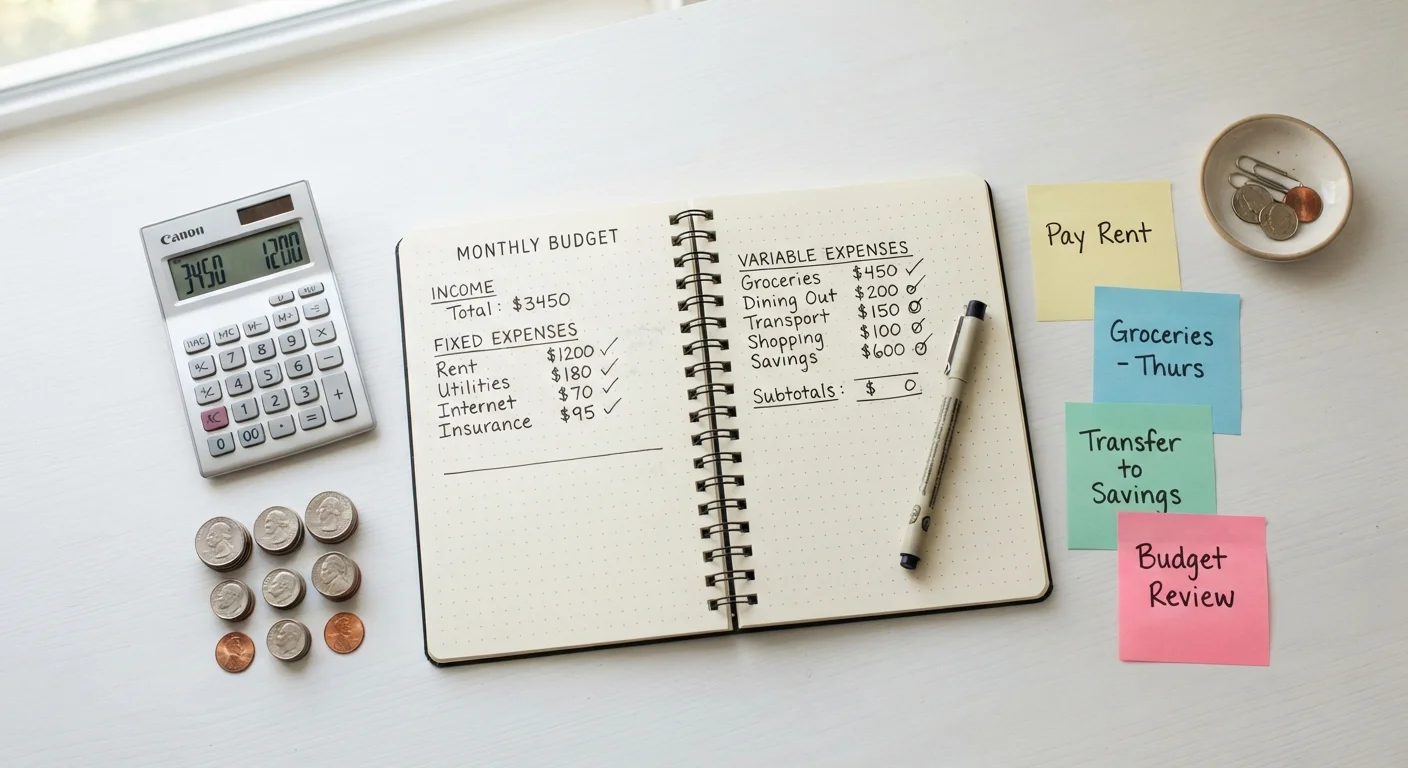
- List all income sources using net (after-tax) figures. Include side income conservatively.
- List all fixed expenses — rent or mortgage, minimum debt payments, insurance premiums, subscriptions. These are non-negotiable in the short term.
- Estimate variable necessities — groceries, utilities, gas — using your three-month average as the baseline.
- Set a savings target before allocating discretionary funds. Treat savings like a bill due every month.
- Allocate what remains to discretionary categories. If there's nothing left, fixed or variable costs need to be reduced — not your savings target.
Many people skip step four entirely, which is why savings rarely happen by default. Automating transfers to a separate savings account on payday removes the temptation to spend the difference.
For ideas on cutting variable costs across everyday categories, the everyday savings guide covers practical strategies from groceries to utilities.
Handling Irregular Income and Surprise Expenses
Freelancers, gig workers, and anyone with variable hours face a structural challenge: budgeting a stable spending plan against an unstable income. The core strategy is to build your baseline budget around your lowest expected monthly income, not your average or best month.
In stronger months, the surplus goes first to an emergency fund, then to savings goals, then optionally to discretionary spending. This creates a natural buffer without requiring discipline in the moment.
For surprise expenses — the car repair, the medical copay, the appliance failure — a dedicated emergency fund is the only reliable answer. A general target is three to six months of essential expenses, held in a liquid account separate from your checking account. Starting with even a small buffer (many financial educators suggest $500–$1,000 as an initial milestone) meaningfully reduces the likelihood that an unexpected cost derails your entire budget.
This article provides general financial information and education. It is not personalized financial advice. Consider consulting a licensed financial professional for guidance specific to your situation.
Adapting Your Budget as Life Changes
A budget isn't a one-time document — it's a living system. Major triggers that require a full budget review include: a new job or income change, moving to a different city, taking on or paying off a significant debt, adding a dependent, or any shift in financial goals.
Outside of major events, a monthly 15-minute review is enough to catch drift — spending categories that creep upward without intention. Many people find that quarterly goal check-ins (asking whether they're on pace for their savings targets) keep the broader picture in focus.
Building smarter spending habits alongside your budget structure accelerates progress. Our guide to smarter everyday spending habits covers the psychology and systems behind sustainable financial behavior.
Budgeting for Major Spending Categories
Some spending categories warrant their own planning approach because of their size or variability:
Housing
A commonly cited guideline is keeping housing costs below 30% of gross income, though in many metro areas this is aspirational rather than achievable. Focus on keeping the ratio as low as possible relative to your market.
Transportation
Vehicle ownership is one of the more underestimated budget categories — fuel, insurance, maintenance, registration, and eventual replacement all add up. If you're evaluating a vehicle purchase, the car buying guidance hub covers how to approach the decision without overspending. Once you own a vehicle, strategies for reducing car ownership costs can help lower ongoing expenses.
Food
Groceries and dining together often rank as the second or third largest budget category for millennials. Meal planning and cooking at home are the highest-leverage levers here.
Debt Repayment
Minimum payments are a fixed cost, but any budget with capacity should direct additional funds toward high-interest debt as a priority. The interest cost of carrying balances significantly reduces your effective income over time.