

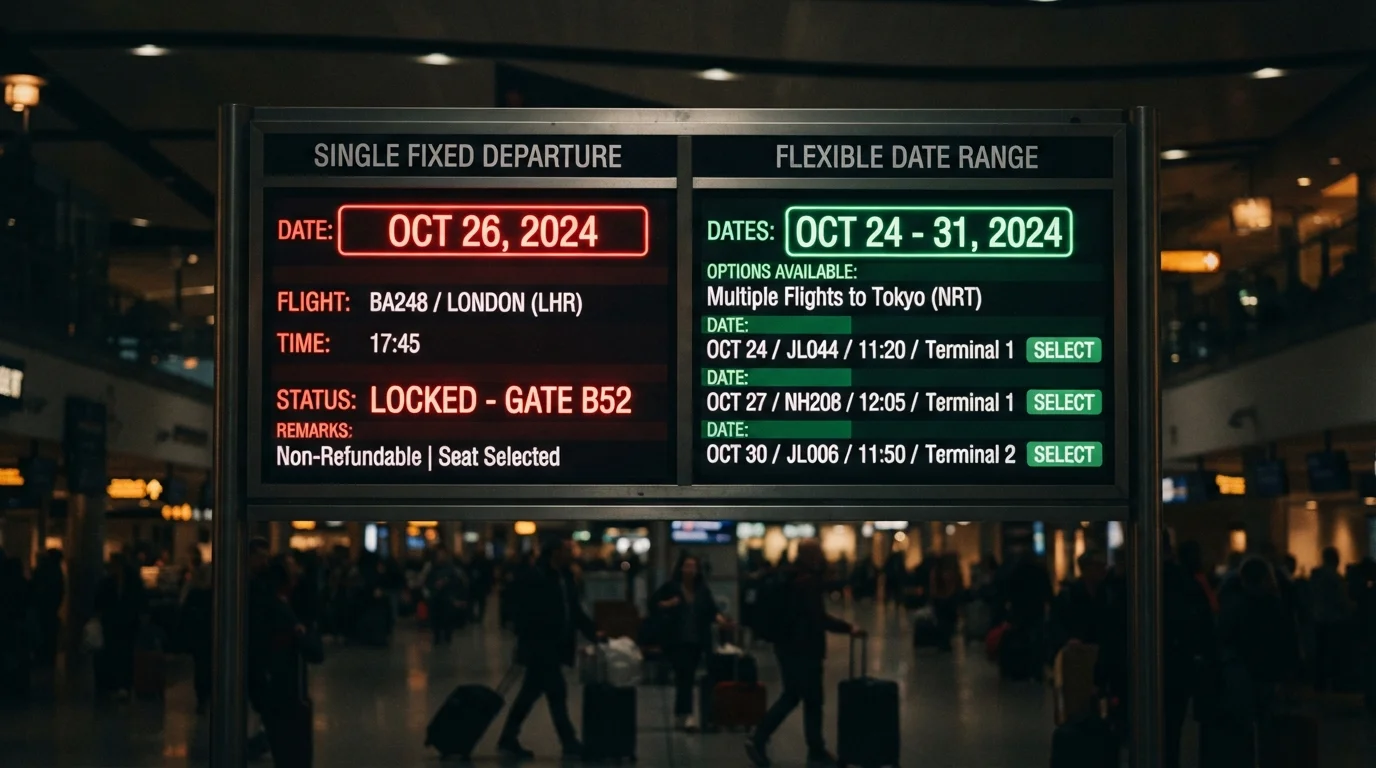
Why Departure Timing Is a Pricing Variable, Not Just a Preference
Airlines don't price seats based on cost to serve — they use dynamic pricing models that adjust fares in real time based on demand, booking pace, seat inventory, and historical patterns. That means the same seat on the same route can cost very different amounts depending purely on when you choose to leave.
This is why departure timing isn't just a personal preference — it's an active financial variable. A traveler locked into a Saturday departure on a popular leisure route is competing with maximum demand. A traveler who can shift to a Tuesday is swimming in a completely different, often cheaper, pricing pool.
For budget-conscious travelers, understanding this distinction is foundational. It's not about gaming the system — it's about recognizing that the system already prices flexibility as a premium, and you can either pay that premium or avoid it. See how advance booking interacts with date flexibility to understand the full picture.
Head-to-Head: How the Two Approaches Compare
The practical differences between flexible and fixed departure strategies show up across several dimensions — not just the ticket price itself.
| Criterion | Flexible Dates | Fixed Dates |
|---|---|---|
| Fare access | Can target lowest-priced windows | Limited to pricing on chosen date |
| Planning complexity | Higher — requires open schedule | Lower — dates decided upfront |
| Best booking strategy | Search fare calendars; pick cheapest day | Book early; set fare alerts |
| Risk of overpaying | Lower on most routes | Higher, especially on weekends and holidays |
| Works best for | Solo travelers, remote workers, open itineraries | Events, group travel, school-calendar constraints |
| Savings potential | Can be significant on demand-variable routes | Limited to advance booking and routing choices |
Fixed-date travelers aren't necessarily making a poor financial decision. Sometimes the constraints are real — a job, a family commitment, or a travel companion's schedule leaves no room to shift. But fixed-date travelers often underestimate how much that rigidity costs, particularly on weekend departures in peak season.
Flexible travelers, on the other hand, need to be realistic: flexibility has limits. Last-minute fare drops are not guaranteed, and some routes — particularly thin international connections — don't show dramatic weekday versus weekend price variance.
When Flexibility Pays Off Most
Date flexibility tends to deliver the largest savings in specific, identifiable scenarios:
- High-demand leisure routes: Flights to beach destinations, ski towns, or tourist-heavy cities show strong day-of-week pricing variation. Midweek departures on routes like New York to Miami or Chicago to Las Vegas frequently carry lower fares than Friday or Sunday equivalents.
- Holiday shoulder windows: Departing two or three days before a major holiday rather than the day before — or the day after rather than the day of return — can reduce costs substantially. The demand cliff between, say, December 23 and December 21 is steep.
- Open-jaw and multi-city itineraries: When building a more complex trip, date flexibility on individual legs creates compounding savings opportunities. For strategies on distributing your budget wisely across multiple stops, see stretching a travel budget across a multi-city trip.
Fare Calendars: A Simple Starting Point
Most major flight search platforms offer a monthly calendar view that displays the lowest available fare for each departure date on a given route. Using this view before committing to any date gives flexible travelers a quick read on where pricing valleys sit. Even fixed-date travelers can use it to verify whether a nearby date is dramatically cheaper — sometimes worth a conversation about shifting plans.
Flexible-date search tools on major fare aggregator sites let you view a calendar of prices across a range of departure dates — a genuinely useful starting point before you commit to any specific day.
Making Fixed Dates Work Harder for Your Budget
If your dates are locked, you're not without options. The main levers are how far in advance you book and which airport or routing you choose.
Domestic fare research generally suggests a booking window of roughly one to three months out tends to capture reasonable pricing on most routes — though this varies by route, season, and carrier. International routes often reward earlier action. Waiting until the week of departure on a fixed date is usually the most expensive position to be in.
Alternate airports are another underused lever. Flying into or out of a secondary airport within reasonable ground-transport distance can offset price differences, though you'll want to factor in that ground transport cost honestly. Ground transport decisions shape your overall budget more than most travelers account for upfront.
Finally, fixed-date travelers benefit from setting fare alerts on their chosen route well in advance. Price drops do occur even on specific dates — particularly if you book during historically lower-demand booking windows like Tuesday afternoons.
~20–25%
Typical fare difference: weekend vs. midweek
Industry fare analysis has consistently found domestic weekend departures pricing meaningfully higher than Tuesday or Wednesday equivalents on leisure-heavy routes.
1–3 months
Domestic booking window with often-reasonable fares
General fare research suggests this advance window frequently captures mid-range pricing on domestic US routes, though results vary significantly by route and season.