

Why Auto Loan Jargon Actually Costs You Money
Walking into a dealership or lender's office without understanding basic financing vocabulary puts you at a disadvantage. Terms like APR, LTV, and amortization aren't just accounting abstractions - they directly determine how much you pay over the life of your loan. A difference of one percentage point in APR on a $20,000 loan over 60 months can add or subtract roughly $550 in total interest. Small numbers, big real-world impact.
This reference breaks down the terms you're most likely to encounter so you can read any loan offer clearly and compare options on equal footing. For broader financial vocabulary, see our plain-language debt and credit glossary.
APR (Annual Percentage Rate)
The true yearly cost of borrowing, expressed as a percentage. Unlike a base interest rate, APR folds in certain fees and charges, giving you a more complete picture of what a loan actually costs.
Loan-to-Value (LTV)
The ratio of your loan amount to the vehicle's market value. A $16,000 loan on an $18,000 car equals roughly 89% LTV. Lenders use LTV to gauge risk - lower ratios typically qualify for better rates.
Amortization
The process of paying down a loan through scheduled payments, where each installment covers both interest and principal. Early payments are interest-heavy; later ones chip away more at the principal.
Principal
The original amount borrowed, not counting interest or fees. Paying extra toward the principal directly reduces what you owe and shortens the loan's life.
Down Payment
Cash paid upfront at purchase, which reduces the loan principal. A larger down payment lowers your LTV, often unlocking a better rate and reducing total interest paid.
Residual Value
The projected value of a vehicle at the end of a lease term, set by the lender. Higher residual values lead to lower monthly lease payments because you're only financing the vehicle's depreciation.
Negative Equity
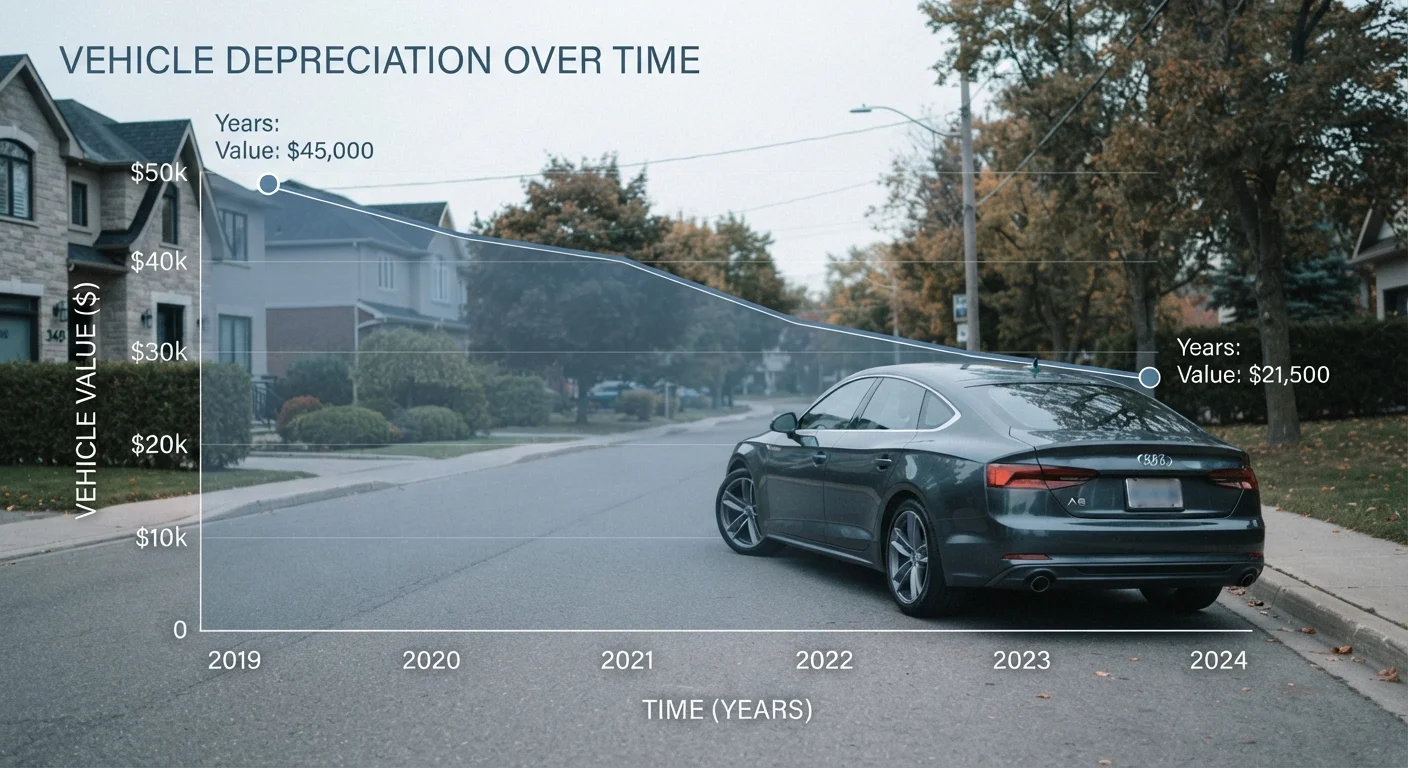
When you owe more on a loan than the car is currently worth - also called being 'upside-down.' This commonly happens when loan terms are long and depreciation is steep early on.
Pre-approval
A conditional offer from a lender stating the loan amount and rate they're prepared to offer, based on a credit check. Having pre-approval before visiting a dealer gives you negotiating leverage.
The Core Terms You'll See on Every Loan Offer
APR is the single most useful number for comparing loan offers. It reflects the full annual cost of the loan - interest plus most mandatory fees - expressed as a percentage. Because lenders calculate base rates differently, APR creates a level playing field.
APR vs. Interest Rate: They're Not the Same
A lender may advertise a low interest rate while burying fees elsewhere in the loan. APR is the number that standardizes comparison because it accounts for those additional costs. Always compare APRs - not just stated rates - when evaluating loan offers from different lenders.
Loan-to-Value (LTV) determines how much risk a lender sees in your loan. If you're financing a vehicle worth $20,000 and borrowing $22,000 (perhaps rolling in negative equity from a trade-in), your LTV exceeds 100% - a red flag for most lenders that often results in a higher rate or outright denial. Keeping your LTV low, primarily through a meaningful down payment, is one of the most effective levers you have. Our article on how depreciation works explains why vehicle values drop faster in early ownership, which directly affects your LTV over time.
Amortization schedule maps out every payment for the life of the loan. In the early months, the majority of your payment goes toward interest. As the balance falls, more of each payment reduces the principal. This is why paying a little extra early in the loan has an outsized effect on total interest paid.
| Average new-car loan term | ~69 months (Experian State of the Automotive Finance Market, 2023) |
| Average used-car loan term | ~67 months (Experian State of the Automotive Finance Market, 2023) |
| LTV threshold most lenders prefer | Below 100% (General industry standard) |
| Typical down payment recommendation | 10-20% of purchase price (Consumer Financial Protection Bureau general guidance) |
| Credit score range for best auto loan rates | 720 and above (Experian, 2023) |
Terms That Trip Up First-Time Buyers
Negative equity is one of the most common and costly traps in auto financing. It happens when your vehicle's market value falls below your outstanding loan balance - which can occur quickly if you financed most of the purchase price, chose a long loan term, or put nothing down. Extending a new loan to cover negative equity from a trade-in compounds the problem. See why low monthly payments can be deceptively expensive for a practical breakdown of how stretched terms cost more overall.
Residual value mainly applies to leases but is worth knowing. It's the lender's estimate of what the car will be worth at lease-end. The gap between the vehicle's current price and its residual value is essentially what you're paying for during the lease.
Pre-approval is underused by buyers who assume they have to finance through the dealer. Getting pre-approved by a bank or credit union before visiting a lot tells you your actual rate and budget - and gives you something concrete to compare against any dealer financing offer. Financing through a dealer versus an outside lender is a decision worth making deliberately, not under showroom pressure.
This article provides general financial information for educational purposes only and does not constitute personalized financial or lending advice. Consult a qualified financial professional for guidance suited to your individual circumstances.