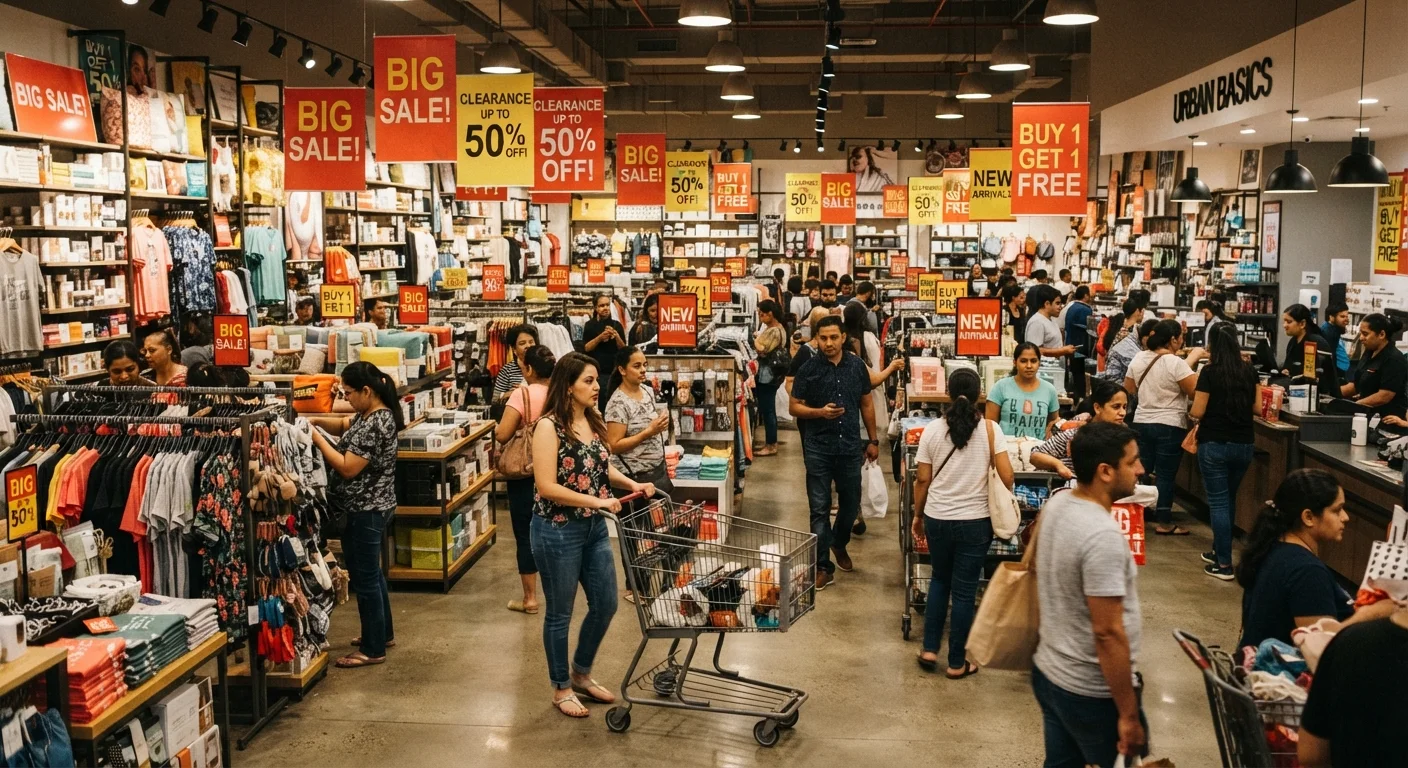

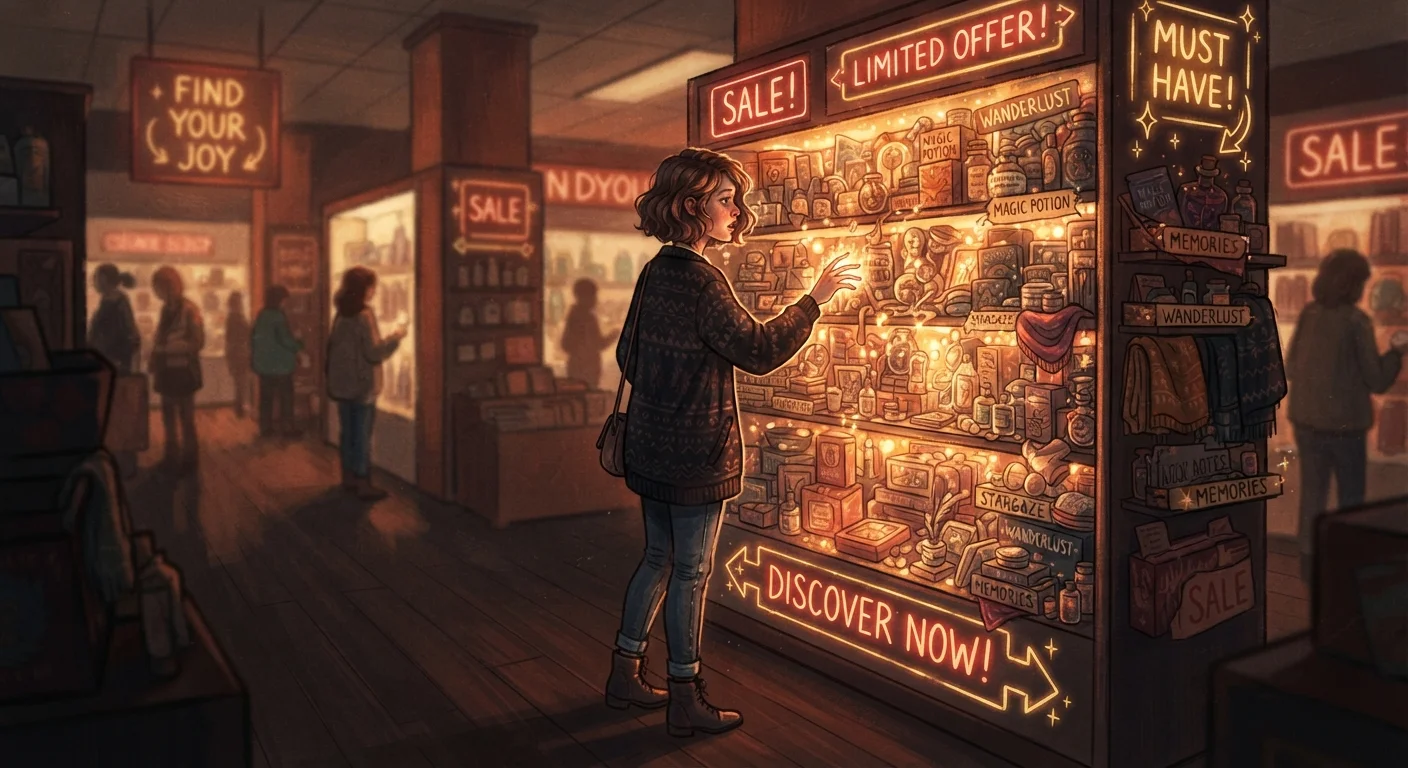
The Brain Was Not Built to Resist a Good Sale
The human brain is wired to prioritize immediate rewards over future benefits - a trait that served our ancestors well but works against modern financial goals. Behavioral economists call this present bias: we systematically overvalue what's available right now relative to what we could gain by waiting. A $30 item feels more compelling at checkout than the abstract future value of having that $30 in savings.
Layered on top of present bias is loss aversion - the well-documented tendency to feel losses about twice as intensely as equivalent gains. Retailers exploit this by framing discounts as savings you'll "lose" if you don't act. "Save $20 today" is not the same as "spend $80 instead of $100," but the brain doesn't process them the same way. The perceived loss of missing the deal creates urgency that feels rational but isn't.
A third lever is social proof: seeing that others have purchased or approved of something reduces perceived risk and amplifies desire. Online review counts, "bestseller" labels, and even the behavior of people around you in a store all quietly shift your willingness to spend. For a deeper look at the situational cues that activate these responses, see spending triggers worth knowing before your next shopping trip.
~40%
Of all retail purchases are unplanned
Consumer research from the Point of Purchase Advertising International association has consistently found that a substantial portion of in-store purchase decisions are made at the point of sale rather than before entering.
2x
How much more painful losses feel than equivalent gains
Loss aversion, documented extensively by Kahneman and Tversky's prospect theory research, shows losses are felt roughly twice as intensely as gains of the same magnitude - a key driver of sale-urgency responses.
24 hrs
Waiting period shown to reduce impulse follow-through
Behavioral research on purchase delay consistently shows that introducing a 24-hour pause between identifying a want and completing a purchase significantly reduces conversion on non-essential items.
Emotional States Are the Accelerator
Cognitive biases create the underlying vulnerability; emotional states determine when it activates. Research in consumer psychology consistently links elevated emotional arousal - stress, boredom, loneliness, excitement - to increased unplanned spending. This is sometimes called retail therapy, though the relief it provides is typically brief and often followed by regret.
Stress spending in particular deserves attention. When cortisol levels rise, the prefrontal cortex (responsible for deliberate decision-making) becomes less effective. The brain defaults to habitual, comfort-seeking behavior - and for many people, purchasing has become that habit. The purchase provides a short dopamine spike that temporarily offsets the stress, reinforcing the pattern.
“The best way to change long-term behavior is to change the environment, not the person. People are products of their situation - make the situation work for you.”
— Richard Thaler, Nobel laureate in Economics and co-author of 'Nudge'
This dynamic also explains why shopping while hungry, tired, or emotionally depleted tends to result in larger, less considered purchases. Reduced cognitive resources mean reduced resistance to environmental prompts. If you've ever returned from a vacation and been startled by how much you spent on things you'd never buy at home, this is the same mechanism - novelty and excitement lower inhibition. For more on this specific pattern, budget overruns that catch travellers off guard covers it in practical detail.
What the Evidence Says Actually Works
Willpower is a limited resource and an unreliable spending guard. The behavioral strategies that hold up in research are structural - they change the conditions under which decisions are made rather than demanding more discipline in the moment.
Friction is the most documented tool. Adding any deliberate delay between impulse and purchase - removing saved payment credentials, requiring a 24-hour wait before completing a cart, or using cash instead of a card - measurably reduces follow-through on unplanned purchases. The emotional driver of the impulse fades; the rational case rarely survives scrutiny.
Implementation intentions - pre-committing to specific "if-then" rules - also show consistent results. "If I want to buy something over $50 that isn't on my list, I'll wait until tomorrow" is more effective than a vague commitment to spend less, because it converts an abstract goal into a concrete decision rule that activates automatically.
Spending audits create awareness that abstract budget tracking doesn't. Reviewing actual card statements category by category, with specific dollar totals, makes spending patterns visceral in a way that estimates do not. It's a difficult exercise, but it tends to shift behavior more durably than any single budgeting app.
Make the Pause the Default, Not the Exception
Remove one-click purchasing options and saved card details from retail sites you visit frequently. The extra 60 seconds it takes to re-enter payment information is often enough friction to kill a genuinely impulsive purchase. Pair this with a simple list rule: if it isn't on a shopping list made before you opened the app or walked into the store, it waits 24 hours.
For a systems-level approach that doesn't depend on motivation staying high, the guide to smarter spending habits that have nothing to do with willpower outlines environment and process-based strategies that work even on low-energy days. And if you want the full behavioral framework, the complete guide to building smarter everyday spending habits covers the end-to-end picture.