

What Is a Monroney Label and Why Does It Exist?
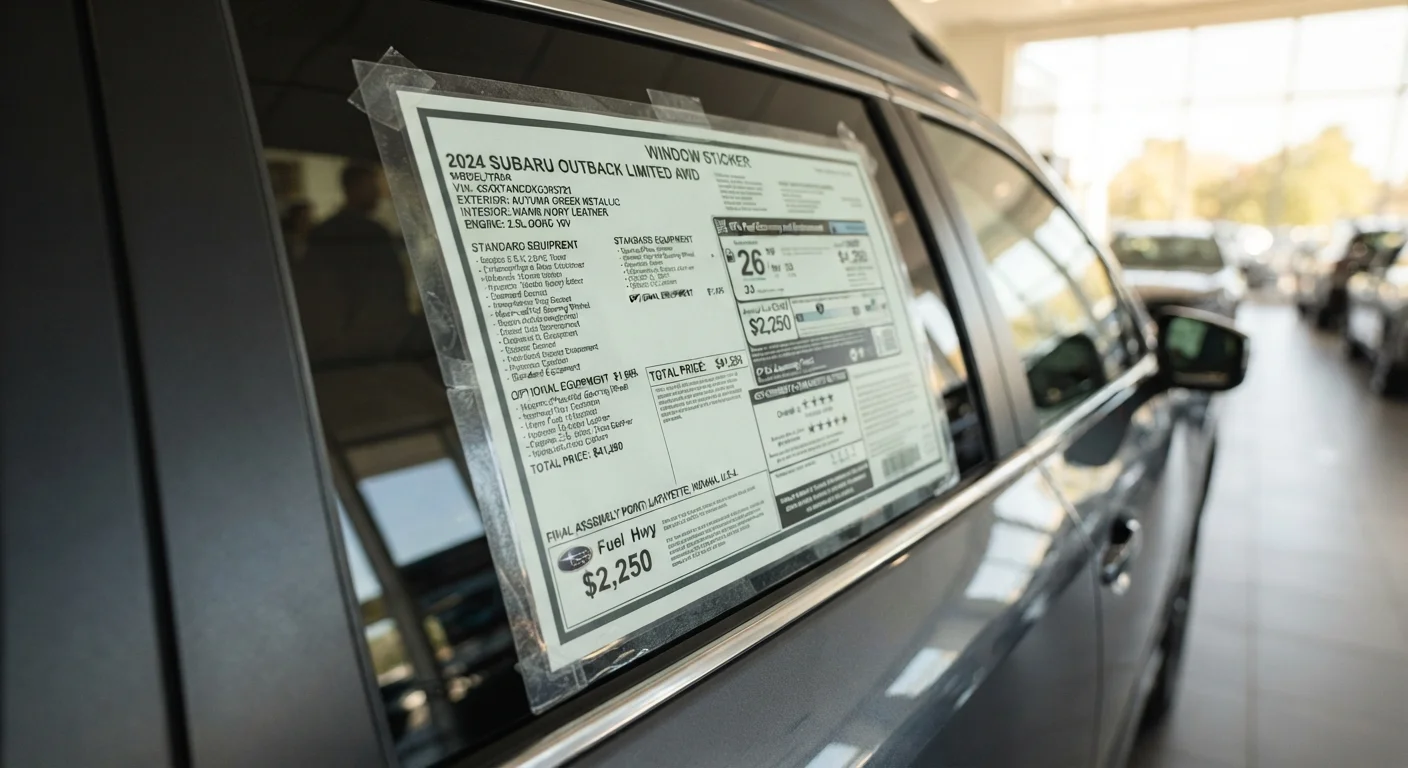
The window sticker on a new car has an official name: the Monroney label, named after the US senator whose 1958 Automobile Information Disclosure Act made it mandatory. Federal law requires every new passenger vehicle sold in the US to display one, and it must remain on the vehicle until the buyer removes it. Dealers cannot legally take it down.
The label is the closest thing to a standardised fact sheet you'll get on a new car. Learning to read it accurately is one of the most practical research steps you can take before entering any negotiation. For context on the wider preparation process, see how to research a car before visiting any seller.
| Legal name | Monroney label (Automobile Information Disclosure Act, 1958) |
| Required by federal law | Yes - on all new passenger vehicles |
| Who can remove it | Only the ultimate purchaser (the buyer) |
| Fuel economy figures provided by | US Environmental Protection Agency (EPA) |
| Safety ratings provided by | NHTSA and IIHS (where available) |
| Destination charge negotiable? | No - set by the manufacturer |
| Dealer add-on sticker negotiable? | Generally yes |
Breaking Down Every Section of the Label
Vehicle Identification and Base Information
The top of the label lists the make, model, model year, trim level, and the vehicle's VIN - a unique 17-character code. The VIN is your tool for pulling vehicle history reports and verifying the car hasn't been recalled without repair.
Standard Equipment
This section lists features included in the base trim at no added cost - things like safety systems, powertrain specs, and infotainment basics. Dealers sometimes treat standard features as selling points for add-ons; knowing what's already included prevents you from paying for something you already have.
Optional Equipment and Packages
Each optional package or individual add-on is itemised with its own price. This is where markups compound quickly. A dealer-installed accessory package might list for several hundred dollars above what the same items would cost purchased separately. Cross-reference each item against the manufacturer's published pricing on their website.
Fuel Economy Estimates
The EPA fuel economy figures - city, highway, and combined - appear prominently. These are estimates generated under controlled lab conditions; real-world results vary based on driving habits, traffic, climate, and vehicle load. The label also includes an estimated annual fuel cost based on a standard mileage assumption, which is useful for comparing models but shouldn't be taken as a precise personal forecast. This feeds directly into total cost of ownership calculations that go beyond the sticker price.
Safety Ratings
If the vehicle has been tested, government safety ratings from the NHTSA may appear here, typically shown as a star rating out of five. Not all new vehicles have ratings at the time of sale - testing can lag a model's release. Check the NHTSA and IIHS websites directly for the most current and complete rating data.
Pricing: MSRP, Destination, and Dealer Add-Ons
The Manufacturer's Suggested Retail Price (MSRP) is exactly that - a suggestion. It does not include the destination and delivery charge, which is a separate, non-negotiable fee set by the manufacturer to cover shipping from the assembly plant. This charge is the same regardless of how close you are to the plant.
Below the manufacturer's figures, dealers often attach a second, supplemental sticker listing additional markups: paint protection, fabric coating, dealer-installed accessories, and so-called market adjustments. These are almost always negotiable and sometimes purely discretionary. Don't conflate a dealer's supplemental sticker with the federally mandated Monroney label - they are two different documents.
Monroney Label
The federally mandated window sticker required on all new vehicles sold in the US under the Automobile Information Disclosure Act of 1958. It must remain on the vehicle until purchased by the consumer.
MSRP
Manufacturer's Suggested Retail Price - the price the automaker recommends a dealer charge for the vehicle. It is a starting point for negotiation, not a fixed or mandatory price.
Destination Charge
A fixed, non-negotiable fee added to the MSRP to cover the cost of shipping the vehicle from the manufacturing plant to the dealership. It is set by the manufacturer and is the same at every dealer.
VIN
Vehicle Identification Number - a unique 17-character alphanumeric code assigned to every vehicle. It can be used to access vehicle history reports and check for open recalls.
EPA Fuel Economy Estimate
Fuel efficiency figures (city, highway, combined) produced by the Environmental Protection Agency under standardised lab conditions. Real-world results typically differ based on driving patterns and conditions.
Dealer Supplemental Sticker
A second sticker added by the dealer - separate from the federal Monroney label - that lists additional charges such as accessories, paint protection, or market adjustments. These costs are generally negotiable.
Using the Label to Avoid Overpaying
The Monroney label is most useful when you treat it as a baseline, not a final price. Compare the itemised optional equipment against what you actually need. If a package bundles five features and you only want two, consider whether the bundle premium is justified. Many buyers pay for trim-level upgrades largely to access a single desired feature - knowing the label's structure helps you evaluate whether a lower trim plus a single add-on would cost less.
Be aware that some popular car-buying beliefs about sticker prices and negotiations don't hold up under scrutiny - common car-buying myths that cost real money covers several of them directly.
Finally, remember that the Monroney label only applies to new vehicles. On used cars, there is no equivalent federal requirement - which is why pre-purchase vehicle history and independent inspection matter more in that context. If you're weighing older, higher-mileage options, high-mileage vehicles often tell a more nuanced story than the odometer alone suggests.