

Why the Confusion Exists
Most drivers hear all three terms at the service counter and nod along - then leave unsure what actually happened to their car. The confusion is understandable: all three jobs involve tyres, all three affect how your car drives, and shops sometimes bundle them together without explanation.
But rotation, balancing, and alignment fix entirely different problems. Mixing them up means you might pay for the wrong service, skip a necessary one, or ignore a symptom that's actively shortening the life of your tyres. For budget-conscious drivers, that's a real cost. Tyre neglect compounds quickly, and understanding which service does what is the first step to avoiding unnecessary expense.
Tyre Rotation: Evening Out the Wear
Rotation means physically moving each tyre to a different position on the vehicle - for example, swapping front tyres to the rear and crossing the rear tyres to the front. The goal is simple: because front tyres handle steering and braking forces differently than rear tyres, they wear faster. Rotating them on a regular schedule - typically every 5,000 to 7,500 miles, though your owner's manual gives the definitive figure - distributes that wear more evenly across all four tyres.
A set of tyres that wears evenly lasts significantly longer than one where two tyres are exhausted while the other two have plenty of tread remaining. You also maintain more consistent handling and traction at all four corners.
Rotation is the lowest-cost of the three services and the one most directly in your control. Many shops include it with an oil change. Whether to do it yourself or have it done professionally depends on whether you have a torque wrench and the ability to safely lift and support the vehicle.
Check Your Owner's Manual First
Rotation patterns vary by drivetrain - front-wheel drive, all-wheel drive, and rear-wheel drive vehicles each have different recommended patterns. Some performance tyres are directional or staggered-fitment, meaning they can't be rotated in the standard way. Your owner's manual specifies the correct pattern for your vehicle, and following it avoids inadvertently creating new wear problems.
Wheel Balancing: Eliminating Vibration
Balancing addresses a different issue entirely. Every tyre-and-wheel assembly has slight variations in weight distribution - even new tyres aren't perfectly uniform. When that imbalance is significant, it creates a rhythmic vibration, usually felt in the steering wheel or seat, that tends to appear at highway speeds around 55-70 mph.
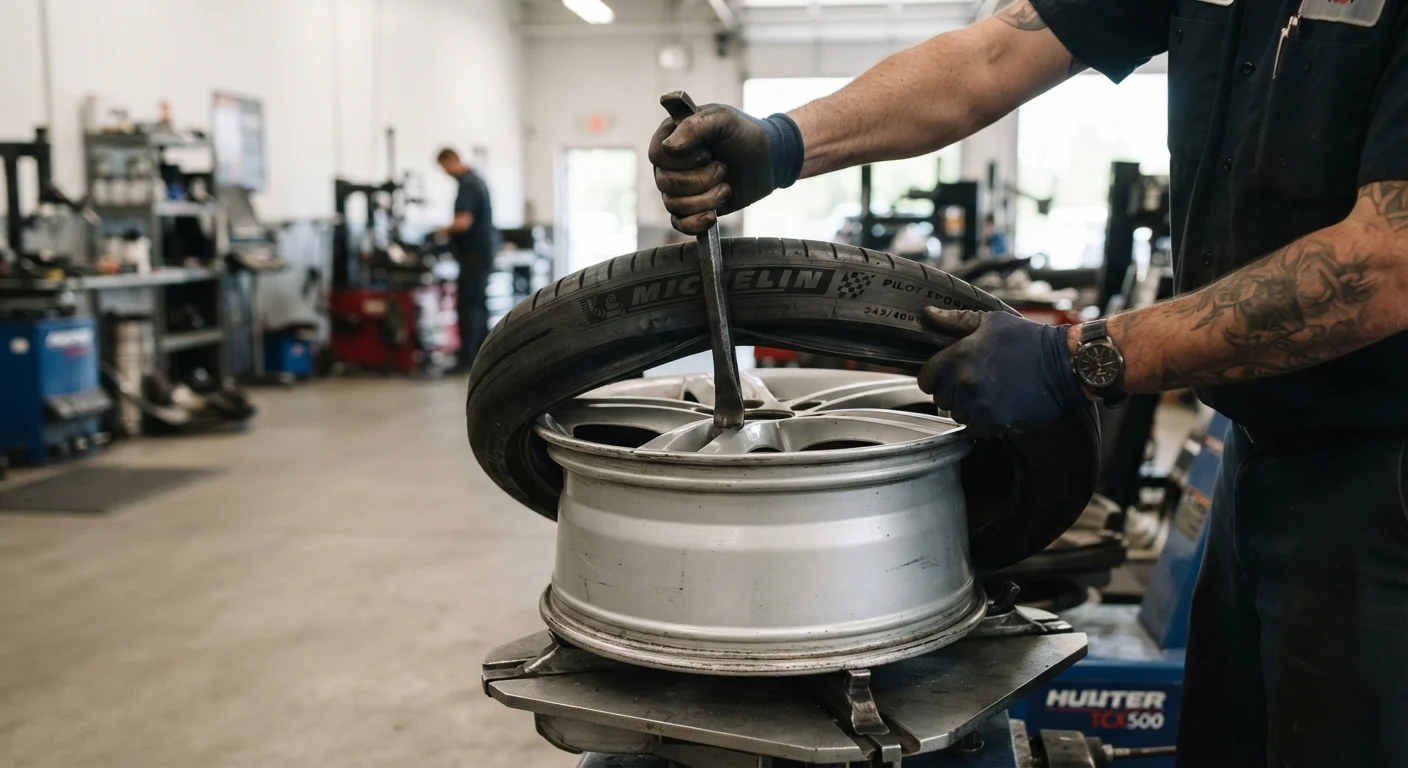
A technician balances a wheel by mounting it on a spin-balancing machine, which identifies where weight is distributed unevenly, then attaching small counterweights to the rim to compensate. The whole process takes minutes per wheel.
Balancing is commonly recommended when you buy new tyres, notice vibration, or have a tyre dismounted and remounted (for a flat repair, for instance). It's also worth doing after hitting a significant pothole, which can knock a wheel out of balance. Driving on an unbalanced wheel doesn't just feel unpleasant - it creates uneven tread wear and additional stress on suspension components.
| Tyre Rotation | Wheel Balancing | Wheel Alignment | |
|---|---|---|---|
| What it fixes | Uneven tread wear across axles | Vibration from weight imbalance | Incorrect tyre angles to road |
| Common symptom it addresses | Front tyres wearing faster than rear | Steering wheel vibration at speed | Car pulling left or right |
| Typical frequency | Every 5,000-7,500 miles | With new tyres or after impact | Annually or after major impact |
| Typical cost range | $0-$25 (often bundled) | $10-$20 per wheel | $75-$150 for four-wheel |
| Can driver DIY? | Yes, with proper equipment | No, requires machine | No, requires alignment rack |
| Risk of skipping | Premature tyre replacement | Suspension wear, rough ride | Rapid uneven tread wear |
Wheel Alignment: Correcting the Angles
Alignment is the most technically involved of the three. It refers to the angles at which your tyres sit relative to the road and to each other - measurements described with terms like camber (tilt inward or outward), toe (pointing inward or outward), and caster (the steering axis angle). When these angles drift out of specification, the consequences include the car pulling to one side, a steering wheel that isn't centered when driving straight, and - most costly - accelerated tyre wear on the inner or outer edges of the tread.
Alignment shifts gradually over time through normal driving, and more suddenly after hitting a large pothole, curb, or road debris. Most manufacturers suggest checking it annually or after a significant impact, but the clearest signal is a car that doesn't track straight without you actively correcting the wheel.
A four-wheel alignment is performed on a specialized rack that measures all four wheel angles simultaneously and adjusts them to manufacturer specifications. It typically costs more than rotation or balancing, but it protects a much larger investment: a misaligned vehicle can wear through a set of tyres in a fraction of their expected lifespan.
For a broader look at how routine maintenance decisions affect long-term costs, common maintenance myths worth questioning can help you separate fact from habit.
How to Use All Three Together
These services work best as a system. Rotating tyres onto a wheel that's out of balance spreads vibration to a new position. Balancing tyres that are wearing unevenly due to poor alignment doesn't address the root cause. Getting an alignment on tyres that are already unevenly worn gives you a corrected angle on a compromised set of tyres.
A practical approach for most drivers: rotate on schedule, balance whenever tyres are dismounted or vibration appears, and check alignment annually or after any significant road impact. If you're also keeping tyre pressure correct, you're doing most of what it takes to get full value from every set of tyres you buy.
When in doubt about which service your car actually needs, ask the shop to show you what they're seeing - a reputable technician should be able to explain the specific measurement or wear pattern that's driving the recommendation.