

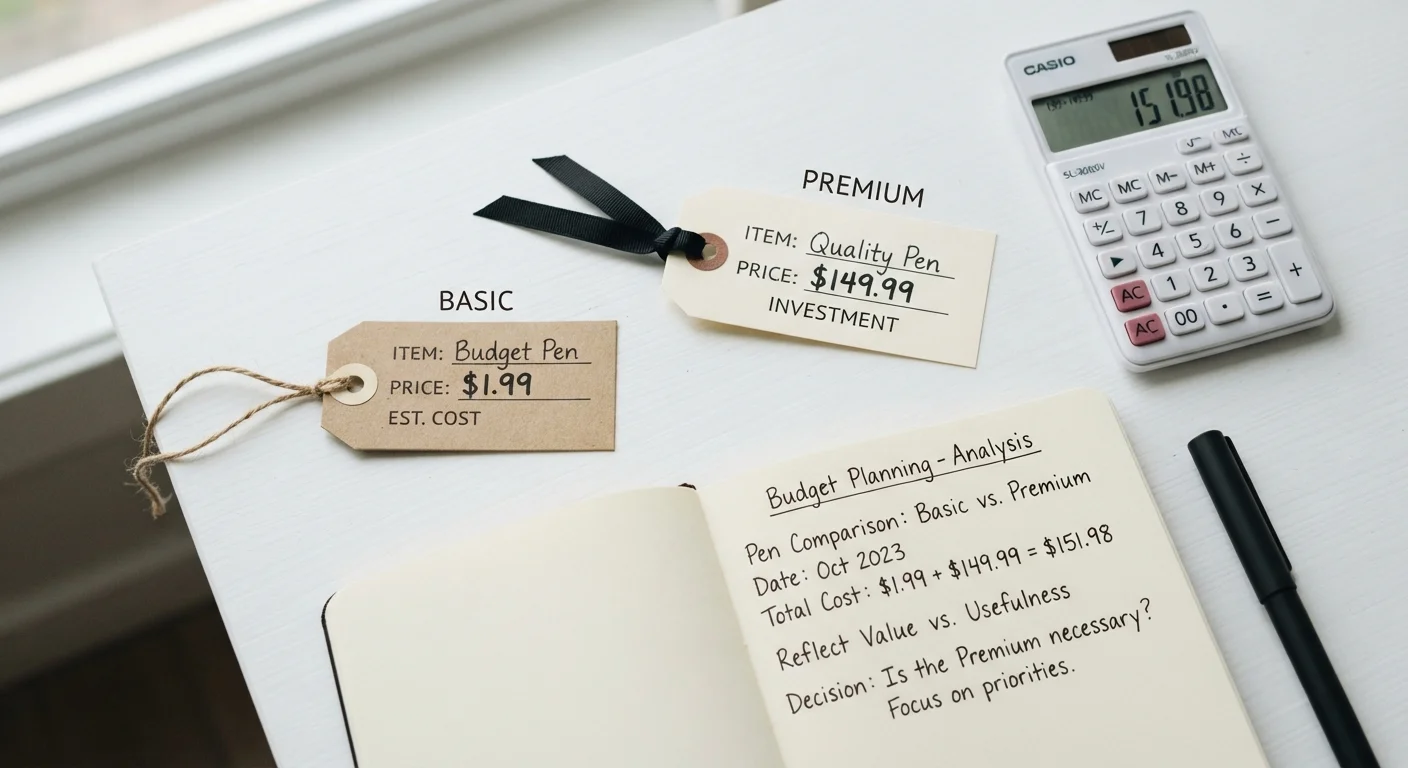
Why Sticker Price Is the Wrong Starting Point
Most purchase decisions begin and end at the price tag - and that's exactly how retailers prefer it. A lower sticker price triggers an immediate sense of savings, even when the item costs more to run, breaks sooner, or needs expensive consumables to function. The result is a predictable pattern: shoppers repeatedly choose the cheaper option upfront and spend more over time.
The lifetime value formula interrupts that pattern by shifting the comparison from a single moment (the purchase) to the full period of ownership. It's the same logic that underlies total cost of ownership analysis, applied as a quick, repeatable two-option test.
The formula works across almost any category: appliances, vehicles, tools, clothing, subscriptions, even groceries sold in different pack sizes. Once you've run it a few times, the calculation becomes second nature - and the instinct to reach for the cheapest option starts to feel like the risky move it often is.
This Is General Financial Education
The method described here is a general-purpose decision-making framework, not personalized financial advice. Individual circumstances - income, credit, opportunity cost, and local market conditions - vary widely. For significant purchases or financial decisions, consult a qualified financial professional.
What You Need Before You Start
The formula is only as reliable as its inputs. Garbage estimates produce misleading outputs, so invest a few minutes gathering realistic figures before you start calculating. Here's what to have on hand:
What you will need
You don't need exact numbers - reasonable estimates with a conservative bias (shorter lifespan, higher repair costs) will produce a more useful result than optimistic guesses. For a deeper look at how to source credible maintenance and reliability data, the durable goods break-even guide covers sourcing strategies in detail.
Spreadsheet application (e.g., any free web-based tool)
Organizes inputs and recalculates instantly when you adjust estimates.
Calculator
Performs the arithmetic for purchase price, annual costs, and lifespan division.
Manufacturer or product documentation
Provides realistic lifespan and maintenance cost figures to plug into the formula.
Running the Formula: Step by Step
Work through each step in order. The process takes under 15 minutes with a basic calculator, and the output is a single cost-per-year figure for each option - directly comparable, regardless of how different the two items look at face value.
Write down the full purchase price for each option
Start with the actual out-of-pocket cost to acquire each item - after any taxes and required fees, but before optional add-ons. If financing is involved, use the total repayment amount (principal plus interest), not the sticker price. Two options that look close in sticker price can diverge significantly once financing costs are factored in.
Estimate annual ongoing costs for each option
Ongoing costs are the most commonly ignored part of the comparison. List every recurring expense you can reasonably anticipate:
- Maintenance and servicing (oil changes, filter replacements, professional tune-ups)
- Consumables (ink cartridges, blades, batteries, pods, bags)
- Repairs - use a conservative annual estimate based on the item's known reliability
- Insurance or warranty premiums if applicable
Sum these into a single annual ongoing cost figure for each option. This number does more work than most people expect.
Estimate the realistic useful lifespan of each option
How long will you actually use - or be able to use - each option before replacing it? Pull from:
- Manufacturer-stated lifespan or warranty period as a floor, not a ceiling
- Aggregated owner reviews reporting real failure timelines
- Your own historical experience with similar products
Express lifespan in years for consistency. If you're comparing something measured in uses (razor blades, coffee filters), convert to an annual-use rate and calculate years from there.
Subtract estimated resale or salvage value
At end of life, some items retain recoverable value - you can sell a used appliance, trade in a vehicle, or return materials. Estimate what you could realistically recover and subtract it from the purchase price before running the formula. If an item has no resale market (consumables, most electronics after several years), enter zero.
Net Acquisition Cost = Purchase Price − Estimated Resale Value
Calculate total lifetime cost for each option
Combine net acquisition cost and the cumulative ongoing costs over the full lifespan:
Total Lifetime Cost = Net Acquisition Cost + (Annual Ongoing Cost × Lifespan in Years)
Run this calculation separately for Option A and Option B. The result is a single dollar figure that represents everything each option will cost you from purchase to disposal.
Divide by lifespan to get cost-per-year
The final step converts total lifetime cost into a comparable annual rate:
Cost Per Year = Total Lifetime Cost ÷ Lifespan in Years
Now place the two cost-per-year figures side by side. The lower number is the more economical choice on a pure cost basis. A more expensive item upfront often lands at a lower cost-per-year once its longer lifespan and lower maintenance costs are accounted for - and vice versa.
Keep a Running Spreadsheet
Once you've run this formula a few times, a simple two-column spreadsheet becomes a permanent decision tool. Log each option's purchase price, estimated annual costs, expected lifespan, and resale value. Over time you'll build a personal reference that sharpens your intuition for any future trade-off.
Putting the Numbers in Context
A raw cost-per-year figure answers the financial question, but it doesn't make the decision for you. A few contextual factors are worth layering on once you have your numbers:
- How certain are your estimates? If one option has high uncertainty around lifespan or repair costs, the formula's output for that option carries more risk. Widen your mental margin of error accordingly.
- Does frequency of use change the math? An item used daily wears faster than one used weekly, which compresses the lifespan and raises the effective cost-per-year. Personal use patterns reshape what counts as value - the formula is a tool, not a verdict.
- What's the cash-flow reality? Even if Option B is cheaper per year, if it requires $800 more upfront and that's a strain on your current budget, that's a legitimate constraint. The formula identifies the economically rational choice; your situation determines whether it's the practical one.
For purchases tied to larger financial decisions - vehicle purchases, major appliances, home equipment - this method pairs naturally with the broader framework in our complete value vs. price guide. The goal isn't to make every decision an exercise in spreadsheet math, but to build the habit of asking: what does this actually cost me over time? That question, asked consistently, is one of the most reliable ways to close the gap between what you spend and what you get.
Lifespan Estimates Are Not Guarantees
Any lifespan figure you plug into this formula is an estimate, not a certainty. Actual durability depends on how heavily you use an item, how well you maintain it, and factors outside your control. Build in a conservative buffer - assume shorter lifespans rather than optimistic ones - to avoid underestimating long-run costs.