

Why Energy Jargon Matters for Your Wallet
Energy efficiency language shows up everywhere - on utility bills, appliance tags, contractor quotes, and lease disclosures. But when the terminology is unclear, it's easy to make decisions that cost more than they save. This reference breaks down the most commonly encountered terms so you can read the fine print with confidence.
Whether you're comparing window ratings before a replacement, reviewing an audit report, or just trying to decode your monthly statement, having a working vocabulary is a practical tool. Start here, then use what you learn in a full room-by-room energy audit to spot where savings are hiding in your own home.
These Terms Appear in Real Places
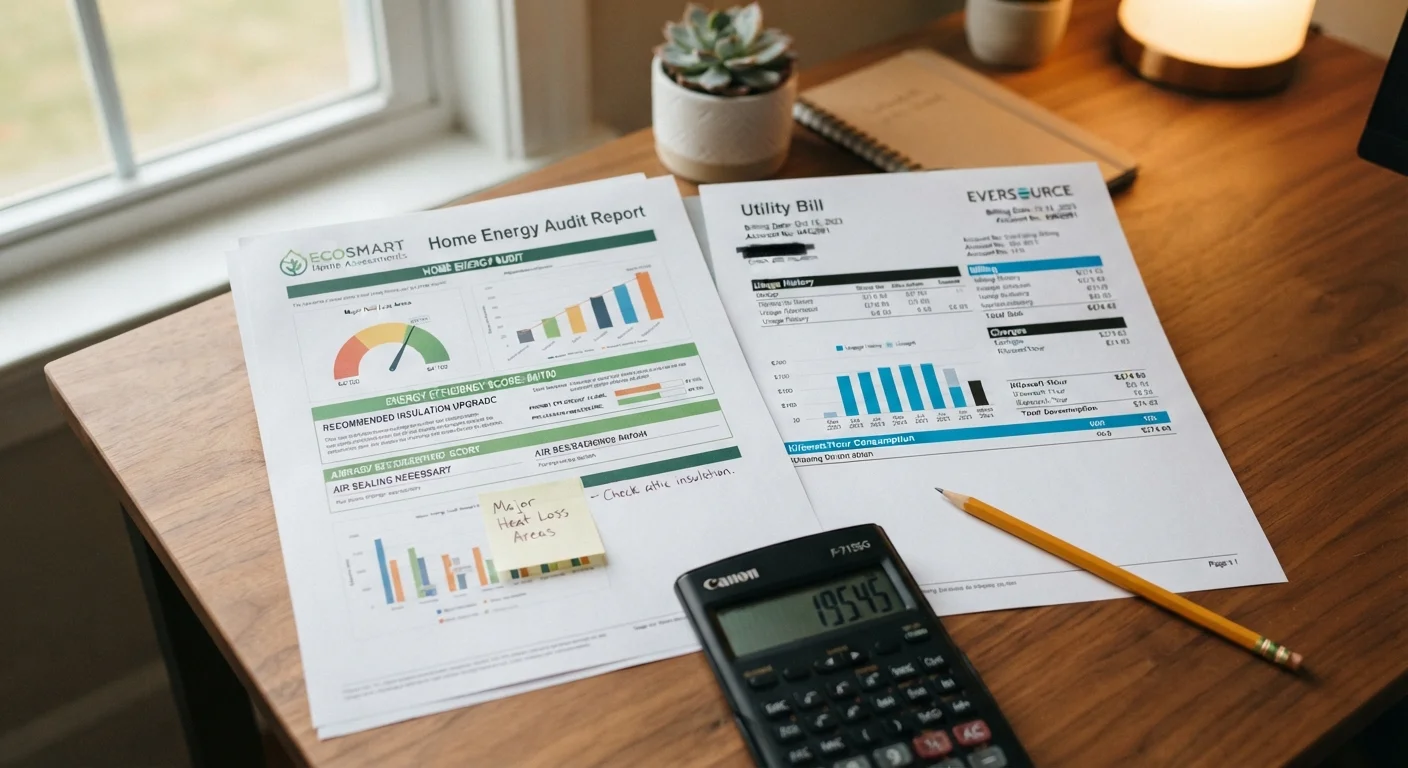
You'll encounter most of these terms on product labels, utility bills, lease disclosures, and energy audit reports - not just in articles. Knowing what they mean before signing a lease or scheduling a contractor visit puts you in a stronger position to ask the right questions and evaluate the answers.
Core Terms: Insulation, Windows, and the Building Shell
The thermal envelope is the foundation of home efficiency. It encompasses everything separating your heated or cooled interior from outdoor conditions - walls, roofing, windows, doors, and the floor above an unheated space. Gaps or weaknesses here force your HVAC system to work harder.
R-value quantifies how well insulation resists heat movement. A higher number is always better. Attics, which are the biggest single source of heat loss in many homes, typically benefit most from upgrades - the DOE recommends R-38 to R-60 for most U.S. climates. A related concept for windows is the U-factor, which works in reverse: lower is better, indicating less heat passes through the glass assembly. Both values appear on product labels and contractor specifications.
A blower door test is how a professional quantifies air leakage in your thermal envelope. Results expressed as ACH50 (air changes per hour at 50 pascals of pressure) tell you how drafty the home is. Tighter is generally better for efficiency, though some minimum ventilation is needed for air quality.
Your Utility Bill: kWh, Demand Charges, and TOU Rates
Most electric bills are built around the kilowatt-hour (kWh) - the unit your meter tracks. Every appliance's running cost can be estimated by multiplying its wattage by hours of use and dividing by 1,000. A chest freezer running 24 hours at 30 watts costs about 0.72 kWh per day.
Phantom load is the electricity that quietly accumulates from devices left plugged in - game consoles, chargers, cable boxes, and smart TVs in standby mode. The DOE estimates this can account for up to 10% of a home's electricity use. Unplugging non-essential devices or using a power strip with a manual switch is a no-cost fix.
If your utility offers time-of-use (TOU) pricing, rates vary by hour. Running the dishwasher or charging an EV during off-peak hours (often overnight or early morning) can meaningfully reduce your bill without reducing comfort. Check your utility's rate schedule to see if TOU is available or already applied to your account. Misconceptions about when and how to shift usage are common - the home energy myths article addresses several of them directly.
HVAC Ratings, Energy Star, and Calculating Payback
Heating and cooling equipment carries standardized efficiency ratings you'll see on yellow EnergyGuide labels. For air conditioners, SEER (Seasonal Energy Efficiency Ratio) is the key number - a higher SEER means lower operating costs. For furnaces and boilers, AFUE measures how efficiently fuel is converted to heat. Upgrading from a 60% AFUE furnace to a 96% AFUE model can significantly reduce heating costs, though upfront equipment and installation costs must factor into the decision.
The Energy Star label - issued by the U.S. EPA - certifies that an appliance meets specific efficiency thresholds. Not all efficient products carry the label, but those that do have been tested against published standards.
Before committing to any upgrade, calculate the payback period: divide the project cost by the estimated annual savings. A $600 attic insulation job saving $150 per year pays for itself in four years. Keeping payback periods in mind helps prioritize which projects to tackle first. For a seasonal lens on timing those projects effectively, see the year-round seasonal energy guide.