

Where the Labels Come From
The good debt/bad debt framework has been part of personal finance conversations for decades. The core idea is simple: borrowing that puts money-making or appreciating assets on your side of the ledger is productive; borrowing to fund spending that disappears — dinner out, a vacation, consumer electronics — leaves you with nothing but the bill.
The shorthand is useful as a starting point, but it can mislead. Labeling a student loan "good" because education is valuable ignores the interest rate, the total amount borrowed, the degree's earning trajectory, and whether you finish the program. Calling all credit card debt "bad" overlooks that a small balance paid off monthly may be a deliberately managed cash-flow tool for some households.
For a broader foundation on how different debt types are structured, see our comprehensive guide to managing debt.
What Typically Gets Called Good Debt
Certain debt categories earn the "good" label because they're associated with assets or investments that tend to produce long-term financial value:
- Mortgages: Real estate has historically appreciated in value over long periods, and mortgage interest rates are generally lower than other consumer borrowing. Building equity while housing yourself is often financially superior to renting — though not universally.
- Federal student loans: When the degree significantly increases earning potential and the loan amount is proportionate to expected income, education debt can pay off. The key qualifier is "proportionate" — borrowing $120,000 for a field averaging $35,000 annually is a very different calculation.
- Small business loans: Borrowing to start or grow a business can generate income that exceeds the cost of the loan, though business outcomes are never guaranteed.
$1.77T
Total U.S. student loan debt outstanding
According to Federal Reserve data, student loan balances have grown substantially over the past two decades, making it the second-largest category of consumer debt after mortgages.
~21%
Average credit card interest rate in the U.S.
Federal Reserve data has shown average credit card rates at or near historic highs in recent years, making revolving balances increasingly expensive to carry.
1 in 3
Americans carrying credit card debt month to month
Survey data from the American Psychological Association and financial research organizations consistently finds that a substantial share of U.S. adults regularly carry a credit card balance.
The critical thread running through all of these is expected return. If the asset or opportunity financed by the debt doesn't deliver that return, the label stops holding.
What Typically Gets Called Bad Debt
Debt earns the "bad" label when it funds consumption rather than assets, and when its interest rate compounds faster than any value it creates:
- High-interest credit card balances: Carrying a revolving balance at rates that commonly exceed 20% APR means the cost of borrowing grows rapidly. A $3,000 balance at 22% APR generates roughly $660 in interest per year — money that produces nothing in return.
- Payday loans: Short-term loans with extremely high effective annual rates are widely regarded by consumer finance researchers as among the most financially harmful debt products available.
- Auto loans for vehicles beyond your means: Cars depreciate the moment they leave the lot. A loan taken on a vehicle that stretches your budget can leave you "underwater" — owing more than the car is worth — within a few years.
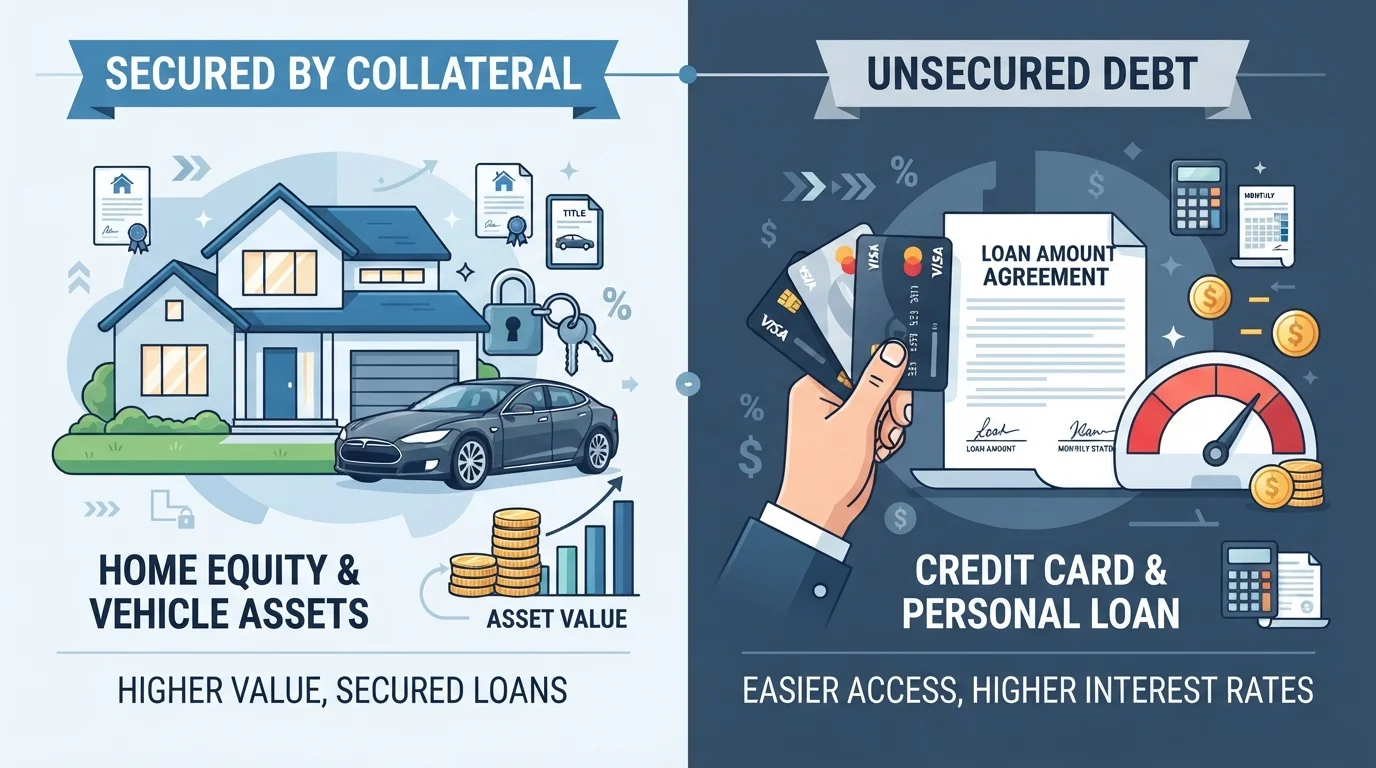
Understanding the legal distinction between secured and unsecured debt — and how each behaves if you fall behind — is also worth knowing. Learn how secured vs. unsecured debt affects your financial risk in more detail.
Focus on Interest Rate, Not Just Category
Before accepting any debt label, check the actual interest rate and run a basic calculation: will what you gain from this borrowing outpace what it costs you in interest? A so-called "good" debt at a high rate can be more damaging than a modest "bad" debt managed responsibly. Use tools like a loan amortization calculator to see the real cost over time.
Why the Distinction Breaks Down in Practice
Real financial life doesn't sort neatly into two columns. Consider a few scenarios where the labels get complicated:
The same mortgage that's "good debt" for a household with stable income and a 20% down payment may be a precarious overextension for someone with variable income and a thin emergency fund. Context — your income stability, total debt load, interest rate, and realistic ability to repay — determines whether any specific debt is working for you or against you.
If you're carrying multiple debts and trying to figure out where to focus your repayment energy, comparing the debt avalanche and snowball methods is a practical next step.
This article is for general informational purposes only and does not constitute personalized financial or legal advice. Consult a qualified financial professional for guidance specific to your situation.