

What Debt Actually Is (And Why It's Not Always Bad)
Debt is money you've borrowed and agreed to repay, usually with interest. That's it. The cultural baggage around the word often makes it feel like a moral failing — it isn't. Debt is a financial tool, and like any tool, how you use it determines the outcome.
Some debt actively works in your favor. A federal student loan that helped you earn a degree with a solid return in lifetime earnings is fundamentally different from a maxed-out credit card charging 24% APR on discretionary purchases. Before you can make a plan, you need to understand what you're dealing with. If you need a refresher on core vocabulary first, the plain-language finance glossary covers the terms you'll encounter most.
APR
Annual Percentage Rate — the yearly cost of borrowing money expressed as a percentage. It includes interest and, in some cases, fees, making it a more complete cost comparison than interest rate alone.
Compound interest
Interest calculated on both your original balance and any interest that has already accrued. On debt, this causes balances to grow faster the longer they go unpaid.
Credit utilization ratio
The percentage of your total available revolving credit (like credit cards) that you're currently using. A lower ratio generally signals lower risk to lenders and supports a healthier credit score.
Debt-to-income ratio (DTI)
Your total monthly debt payments divided by your gross monthly income. Lenders use this figure to assess how much additional debt you can realistically manage.
Minimum payment
The smallest amount you're required to pay each billing cycle to keep an account in good standing. Paying only the minimum on high-interest debt significantly extends repayment time and total cost.
Secured vs. unsecured debt
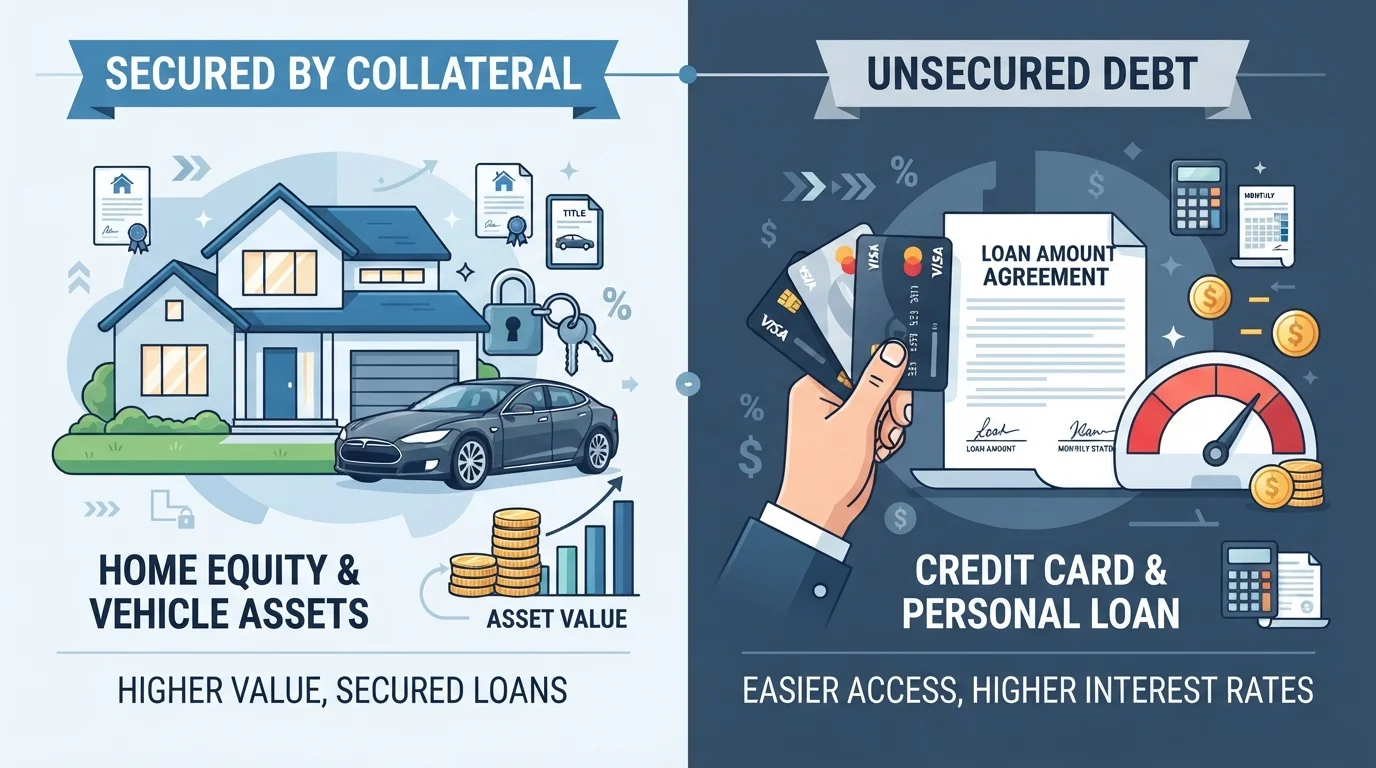
Secured debt is backed by collateral (an asset the lender can claim if you don't pay). Unsecured debt has no collateral — the lender's recourse is legal action rather than seizing property.
Types of Debt You're Likely Carrying
Millennial households typically carry a mix of debt types, each with different rules, risks, and costs. The two broadest categories are secured debt — backed by an asset a lender can repossess (like a mortgage or auto loan) — and unsecured debt — backed only by your promise to repay (like credit cards and most personal loans). For a deeper look at how these categories affect your financial risk, see our guide on secured vs. unsecured debt.
- Student loans: Federal loans offer income-driven repayment options and protections that private loans typically don't. Know which you have.
- Credit card debt: Usually the highest-interest debt in a household — often 18–29% APR — and therefore the most costly to carry.
- Auto loans: Secured, typically lower interest, but the vehicle depreciates, so owing more than it's worth is a real risk.
- Medical debt: Increasingly reported to credit bureaus differently than other debt; often negotiable directly with providers.
How Interest Compounds — and Why It Matters
Compound interest means you pay interest not just on what you originally borrowed, but on any unpaid interest that's already accumulated. On a savings account, this works in your favor. On a debt balance, it works against you.
Consider a $5,000 credit card balance at 22% APR. Making only minimum payments, you could spend years paying it off and end up paying significantly more than the original balance in interest alone. The math accelerates the longer you wait — which is why even modest extra payments made early have an outsized effect on total cost.
Small Extra Payments Add Up Fast
Even adding $25–$50 per month above your minimum payment on a high-interest balance can meaningfully reduce total interest paid and shorten your payoff timeline. You don't need a windfall to make progress — consistency beats size when it comes to extra payments.
Understanding this mechanism is the single most important reason to prioritize high-interest debt. The budgeting terms reference can help you get comfortable with concepts like APR and minimum payment calculations.
Core Strategies for Paying Down Debt
Two structured approaches dominate personal finance guidance on debt repayment:
- Debt Avalanche: Pay minimums on all balances, then direct every extra dollar toward the highest-interest debt first. Mathematically optimal — you pay the least total interest.
- Debt Snowball: Target the smallest balance first, regardless of rate. Each paid-off account creates a motivational win that can sustain momentum.
Both are legitimate. The right one for you depends on your numbers and your psychology. Our detailed comparison — debt avalanche vs. debt snowball — walks through when each approach makes the most sense.
Before choosing a strategy, build a clear picture of every debt: balance, interest rate, minimum payment, and due date. A simple spreadsheet or even a notepad works. Many people find that this snapshot alone reduces anxiety because it replaces a vague fear with concrete numbers.
How Debt Affects Your Credit Profile
Your credit score influences the interest rates you're offered on future loans, rental applications, and sometimes even employment background checks. Debt affects your score through several mechanisms:
- Credit utilization ratio: The percentage of your available revolving credit that you're using. High utilization drags scores down quickly.
- Payment history: The single largest factor in most scoring models. One missed payment can linger on your report for years.
- Debt mix: Having a variety of account types (installment loans, revolving credit) can modestly improve scores over time.
Paying down balances — especially on credit cards — often produces a faster score improvement than any other single action. Consistent on-time payments matter just as much over the long run. For broader financial foundations that support healthy credit habits, the Budget Basics hub is a useful starting point.
When to Seek Outside Help
If your debt feels genuinely unmanageable — minimum payments are consuming most of your income, or you've fallen behind — it may be time to look beyond DIY strategies. Two commonly confused options are debt management plans and debt settlement. They work very differently and carry different consequences for your credit and finances. The distinction is explained in detail in our guide to debt management plans vs. debt settlement.
Nonprofit credit counseling agencies — many affiliated with the National Foundation for Credit Counseling (NFCC) — offer free or low-cost consultations and can help you evaluate your options without a sales agenda. Be cautious of for-profit debt relief companies that charge large upfront fees or make guarantees they can't keep.
This article is for general informational and educational purposes only and does not constitute personalized financial, legal, or tax advice. For guidance specific to your situation, consult a licensed financial professional.