

What Makes Debt 'Secured' or 'Unsecured'?
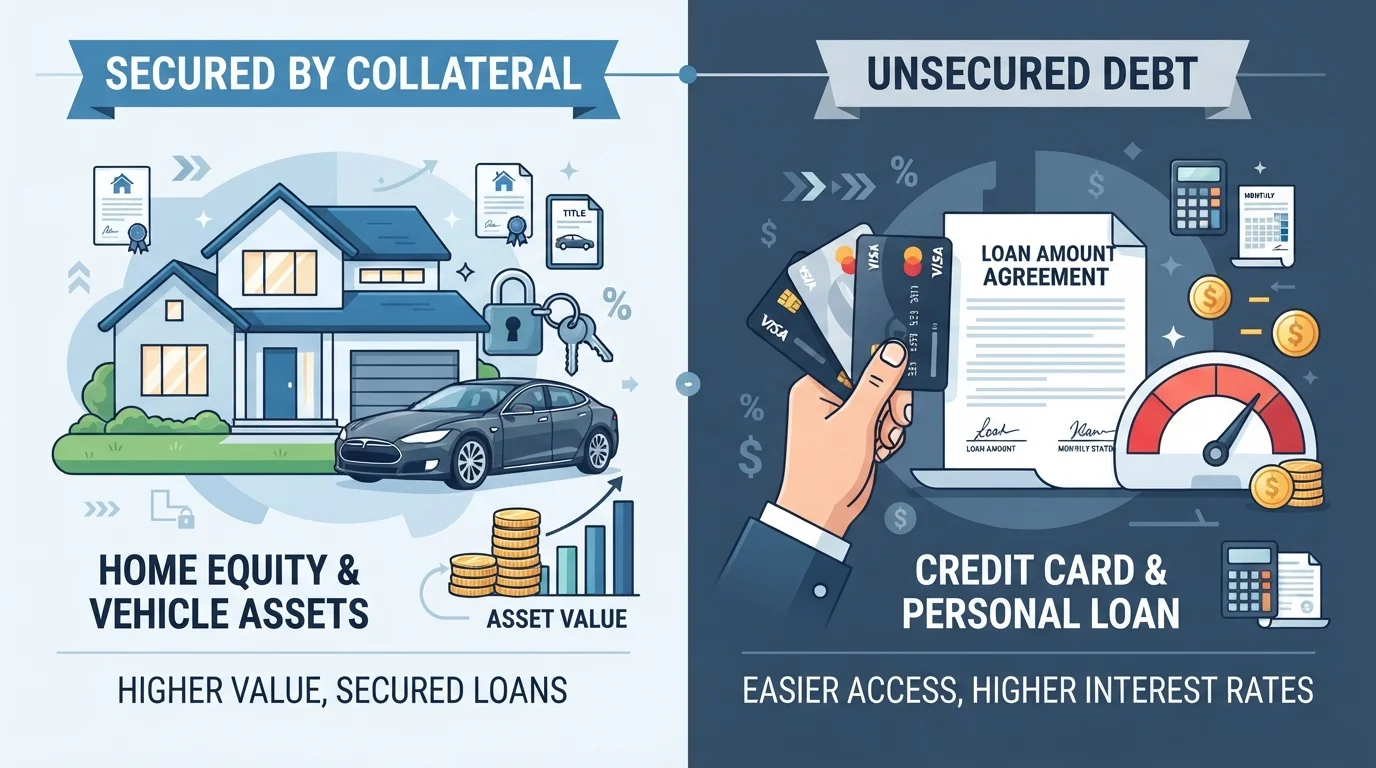
The fundamental difference between these two debt categories comes down to one word: collateral. Collateral is any asset — a house, a car, a savings account — that you pledge to a lender as a guarantee of repayment. If you stop paying, the lender has a legal right to seize that asset to recover what they're owed.
Secured debt is any loan or credit arrangement backed by collateral. Common examples include mortgages, auto loans, and home equity lines of credit (HELOCs). Because the lender has a safety net, they typically offer lower interest rates — the risk is partly transferred to you in the form of potential asset loss.
Unsecured debt carries no collateral. Credit cards, personal loans, medical bills, and student loans (in most cases) fall into this category. Without an asset to claim, lenders price in more risk through higher interest rates. If you default, they can't immediately take your property — but they have other enforcement tools, including sending accounts to collections and pursuing court judgments.
For a plain-language breakdown of terms like APR and charge-offs that come up with both debt types, see our debt and credit glossary.
| Criterion | Secured Debt | Unsecured Debt |
|---|---|---|
| Collateral required | Yes (home, car, asset) | No |
| Typical interest rates | Generally lower | Generally higher |
| Common examples | Mortgage, auto loan, HELOC | Credit cards, personal loans, medical bills |
| Lender recourse on default | Repossession or foreclosure | Collections, lawsuits, wage garnishment |
| Impact on credit report | Yes — delinquencies reported | Yes — delinquencies reported |
| Immediate physical risk | High (loss of asset) | Lower initially, escalates over time |
What Actually Happens When You Miss Payments
The consequences of falling behind diverge sharply depending on which type of debt you hold.
With secured debt, lenders can move relatively quickly to recover their collateral. Auto lenders in many states can repossess a vehicle after a single missed payment, though most send notices first. Mortgage lenders typically begin foreclosure proceedings after 90–120 days of nonpayment, though timelines vary by state. The point is: the lender has a clear, legally defined path to recoup losses that doesn't require suing you.
With unsecured debt, the lender's options are more indirect. After missed payments, they'll report delinquencies to credit bureaus, charge off the account (typically after 180 days), and may sell it to a collections agency or sue you in civil court for a judgment. A court judgment can lead to wage garnishment or a lien on property — serious consequences, but ones that take time and legal process to reach.
7 years
How long delinquencies stay on credit report
Under the Fair Credit Reporting Act (FCRA), most negative items — including missed payments on any debt type — can remain on your credit report for up to seven years.
180 days
Typical timeline before unsecured debt charge-off
Credit card issuers and other unsecured lenders generally charge off accounts after approximately 180 days of nonpayment, per standard industry and regulatory practice.
~20%+
Average credit card APR in the US
Federal Reserve data has shown average credit card interest rates consistently above 20% in recent years, highlighting the cost difference versus most secured loan products.
In either case, late and missed payments are reported to the three major credit bureaus and can remain on your credit report for up to seven years. The credit damage is real regardless of debt type. For broader context on how different debts fit into your financial picture, the complete guide to managing debt is a useful starting point.
Interest Rates, Access, and the Trade-Offs
Secured debt almost always carries lower interest rates because the lender's risk is reduced by the collateral. A mortgage might carry an interest rate several percentage points below what you'd pay on a personal loan for a similar amount. That difference compounds significantly over years of repayment.
Unsecured debt is generally easier to access — you don't need to own an asset to qualify — but the cost of borrowing is higher. Credit card APRs frequently exceed 20%, while personal loan rates vary widely based on your credit profile. This doesn't make unsecured debt inherently bad; it means the math of carrying a balance matters more. See why the good debt vs. bad debt distinction isn't always simple for more on evaluating borrowing decisions.
One practical implication: if you carry both types simultaneously and cash gets tight, most financial educators suggest prioritizing secured debt payments to protect critical assets. Once that's stable, you can focus on tackling high-interest unsecured balances — and strategies like the debt avalanche or debt snowball method can help you choose how to attack them. The debt avalanche vs. debt snowball comparison walks through both approaches in detail.
Don't Confuse 'Secured Credit Card' With Secured Debt
A secured credit card — where you deposit cash as collateral to get a small credit limit — is a credit-building tool, not the same as taking out a secured loan against an asset like a home or car. The mechanics differ significantly. A secured credit card's collateral is typically just your own deposit, and it's designed to help people establish or rebuild credit history rather than finance a major purchase.
This article is for general informational purposes only and does not constitute personalized financial or legal advice. Consult a qualified financial professional for guidance specific to your situation.