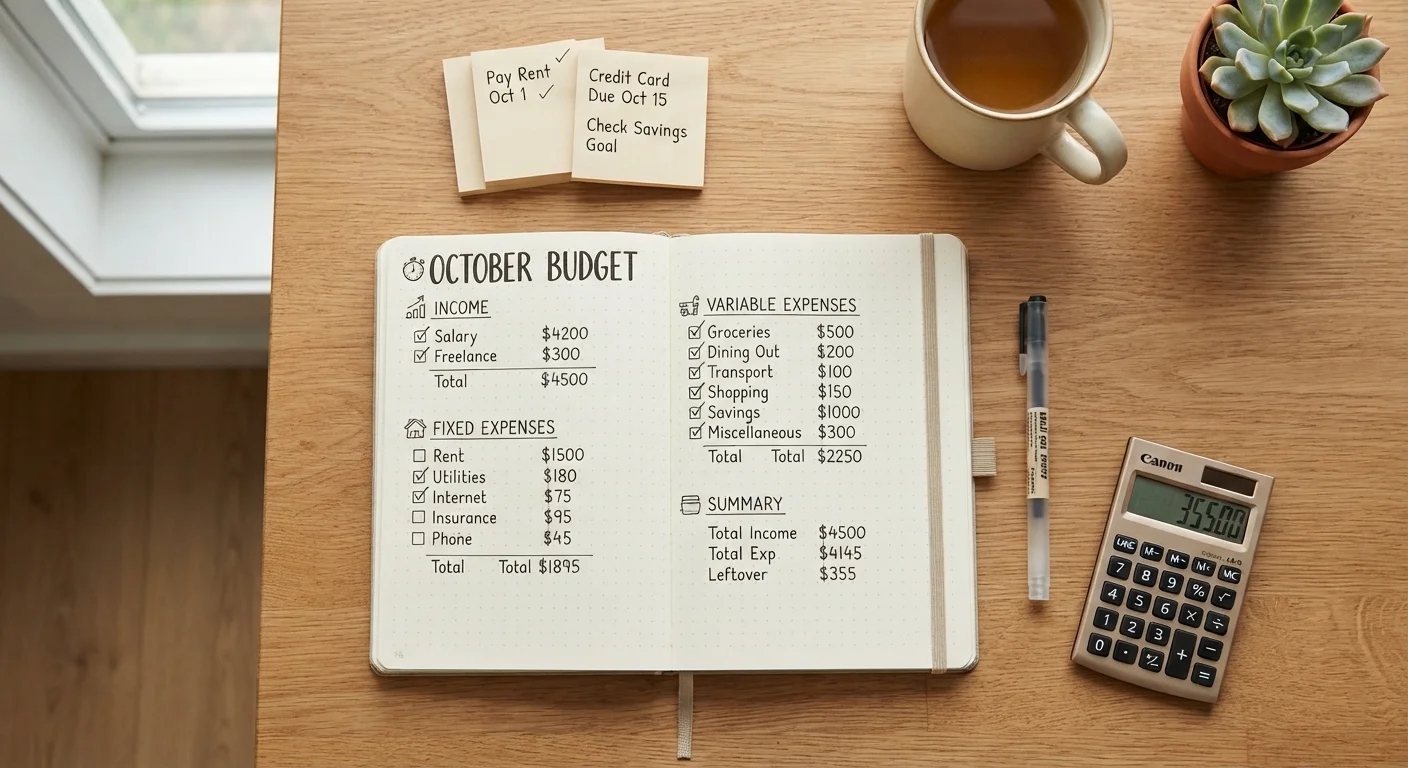


What a Budget Actually Does (and Doesn't Do)
A budget is a spending plan you write in advance. That's it. It doesn't mean you stop buying things you enjoy — it means you decide where your money goes before the month spends it for you. That distinction matters, because most first-time budgeters abandon the process after treating it like a punishment rather than a tool.
A budget also won't fix a structural income problem overnight. If your essential costs reliably exceed your income, a spending plan highlights that gap clearly — which is genuinely useful — but closing it requires income growth, reduced fixed costs, or both. What a budget will do is stop vague financial anxiety from running the show and replace it with numbers you can actually work with.
Net income
The money you actually receive after taxes and deductions are taken out of your paycheck — the real figure available to spend or save.
Fixed expense
A cost that stays the same every month, like rent or a loan payment, making it easy to predict but harder to reduce quickly.
Variable expense
A cost that changes month to month based on your choices or habits — groceries, dining, and entertainment are common examples.
Budget surplus
When your income exceeds your expenses for the month, leaving money that should be deliberately assigned to a goal rather than left untracked.
Budget deficit
When your expenses exceed your income for the month, signalling that spending needs to be reduced or income needs to increase.
Irregular expense
A cost that doesn't occur every month but is predictable — such as an annual subscription or car registration — and should be planned for monthly.
Step 1: Pin Down Your Real Take-Home Income
Your budget starts with the money that actually hits your bank account — after taxes, health insurance deductions, and any retirement contributions your employer pulls from your paycheck. This is your net income, and it's the only number that matters here. Using your gross (pre-tax) salary as the base is one of the most common first-budget mistakes.
If you're paid twice a month, multiply one paycheck by two. Paid every two weeks? Multiply by 26 and divide by 12 to get a reliable monthly figure. Include any consistent secondary income — a part-time gig, freelance retainer, or rental income — but only if it arrives every month without fail. Irregular or unpredictable income should stay off the base figure for now.
Step 2: List and Categorise Every Expense
Pull three months of bank and credit card statements. Go line by line and sort every charge into two groups:
- Fixed expenses: amounts that don't change month to month — rent, car loan payment, insurance premiums, minimum debt payments.
- Variable expenses: amounts that fluctuate — groceries, gas, dining out, clothing, entertainment, personal care.
Also create a third bucket for irregular expenses: annual subscriptions, vehicle registration, holiday gifts, medical co-pays. These don't show up every month but they are predictable. Divide each one by 12 and treat that monthly share as a real cost.
Don't edit or judge the list yet. The goal at this stage is an honest picture. Underestimating variable spending is how budgets fall apart in week two — something explored in detail in our piece on why budgets fail early.
Use Three Months, Not One
A single month of statements can be misleading — maybe you had an unusual medical bill or skipped a grocery run. Three months of data smooths out one-off events and gives you a more accurate baseline for each spending category. This extra ten minutes of prep saves a lot of frustration when your first budget feels 'wrong.'
Step 3: Compare, Cut, and Assign
Subtract your total monthly expenses from your net income. You'll land in one of two places:
- Surplus: Income exceeds expenses. Assign the surplus deliberately — to an emergency fund, debt repayment, or a savings goal. An unassigned surplus tends to vanish into small untracked purchases.
- Deficit: Expenses exceed income. This requires cuts. Start with variable categories — subscriptions you've forgotten about, dining frequency, or discretionary spending — before touching fixed costs, which are harder to reduce quickly.
A simple framework to guide allocations: many financial educators reference a rough split of roughly 50% of take-home pay toward needs, 30% toward wants, and 20% toward savings and debt repayment. This is a starting point, not a rule — adjust based on your actual fixed cost structure, which in high-rent cities often pushes needs above 50%. For a deeper comparison of allocation frameworks, see budgeting methods compared.
Step 4: Choose a Simple Tracking Method
A budget written once and never checked is just a list. Tracking is what gives it teeth. Choose the lightest-weight method you'll actually maintain:
- Spreadsheet: One tab per month, income at the top, categories below. Free and fully customisable.
- Envelope method: Withdraw cash for variable categories and physically separate it. Spending stops when the envelope empties.
- Budgeting apps: Many connect to bank accounts and auto-categorise transactions. Useful if manual entry feels like too much friction.
If you want a framework that assigns every dollar a specific job before the month starts, zero-based budgeting is worth exploring as a next step.
No Tracking System Is Perfect
Every method has gaps — apps miscategorise transactions, cash spending goes unrecorded, and spreadsheets rely on you remembering to update them. The goal isn't perfect data; it's directional awareness. A budget that's 85% accurate and maintained consistently outperforms a perfect system you abandon after two weeks.
Keeping the Budget Alive Month After Month
The first month's budget will be imperfect — that's expected. What separates people who stick with budgeting from those who quit is a short monthly review, not willpower. At the end of each month, compare planned amounts to actual spending in each category, note which categories were consistently off, and adjust the next month's numbers accordingly.
Life changes budgets: a rent increase, a new insurance premium, a pay raise. Run this review before the new month starts rather than after it's already underway. A structured approach to this process is covered in the monthly budget reset checklist. And for a complete end-to-end view of how budgeting fits into longer-term financial stability, the personal budgeting framework is a useful companion resource.
This article is for general informational and educational purposes only and does not constitute personalised financial advice. Consider consulting a qualified financial professional for guidance specific to your situation.